The Social
Triangle Method
A simple, evidence-backed eye contact technique for natural, confident human connection. Used by therapists, actors, and top performers and learnable in a day.
What is the Social Triangle Method?
A structured gaze technique that mimics what naturally confident, high-rapport communicators already do and makes it learnable for everyone else.
There's no class for this. No syllabus covering how long to hold eye contact. No lesson on how to enter a group conversation without it being awkward. No coach explaining that small talk isn't actually about the weather. Nobody sits you down at 14 and walks you through the unwritten rules.
Neurotypical people absorb this stuff through thousands of low-stakes social interactions spread over years. It goes in automatically, but if your brain works differently, or anxiety gets in the way, or you just had a rough social environment growing up, that process gets interrupted.
So you arrive at adulthood knowing how to do genuinely hard things, but you still dread walking into a party alone. You still can't hold eye contact without it feeling like a staring contest or a crime. That gap can feel shameful, but understand that it's just a gap and gaps can be filled.
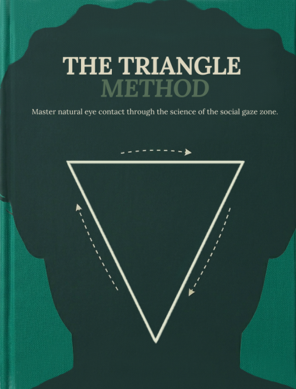
The Triangle Method is where we start. Rather than locking onto one eye (which creates intensity and discomfort for both people), you gently rotate your focus within the natural triangle formed by the two eyes and the mouth. It's what relaxed people do automatically. It produces warm, natural-feeling eye contact without the staring contest energy.
The science behind it ties directly to how your nervous system broadcasts threat vs. safety signals. When your gaze is stiff and locked, it reads as either aggressive or anxious. When it moves naturally within the social zone: the eyes-to-mouth triangle, it signals
active listening and engagment. Rather than maintaining a fixed, unbroken stare which research shows triggers discomfort and threat appraisal, you move your gaze slowly and naturally between these three points in a repeating loop, spending roughly one to two seconds on each.
The triangle formed by the two eyes and the mouth corresponds to the region of the face that the human visual system prioritises when processing social information. This area, sometimes called the "social triangle" in face perception literature, is where gaze, expression, and speech cues converge. By deliberately anchoring your attention within this zone, you replicate the gaze patterns of high-rapport communicators and make that behaviour repeatable, even under pressure.
Your gaze is already sending a signal before you say a single word. You might be showing that you're present, distracted, safe, threatening, interested or just elsewhere. Research consistently ties appropriate eye contact to how confident, trustworthy, and engaged someone is perceived to be. There is real neurochemistry behind it too. Mutual eye contact triggers the release of oxytocin in both people (the bonding hormone). A moment of genuine eye contact with a stranger can feel oddly significant because, biologically, it is.
Three points. One natural loop.
The method follows four steps that cycle continuously throughout a conversation. Once it becomes habit, it runs on autopilot while you focus entirely on what is being said.
Land on one eye
Begin with either the left or right eye. Hold softly for one to two seconds. It's long enough to register attentiveness, but short enough to avoid the intensity of a sustained stare.
Drift to the other eye
Move your gaze slowly and naturally to the opposite eye. This lateral micro-movement signals engagement without dominance and mirrors patterns observed in natural high-empathy conversation.
Drop briefly to the mouth
A short glance toward the mouth breaks accumulated eye-contact tension. Humans naturally observe the mouth during speech processing. This point feels instinctive rather than rehearsed.
Repeat the loop
Return to the starting eye and continue the rotation. The pace should feel conversational, not mechanical. With practice, the pattern becomes entirely automatic within one to two weeks.
Why it works: The Science
The effectiveness of the Social Triangle Method is grounded in several converging areas of research. This is not a technique invented by a self-help author. It formalises what eye-tracking studies have been observing for decades.
Gaze distribution in face perception
Eye-tracking studies consistently show that humans focus the majority of their attention within the triangle formed by the eyes and mouth. This region contains the highest density of socially relevant cues, including gaze direction, micro-expressions, and articulatory movements. Gaze that stays within this zone is processed as socially fluent.
The discomfort of sustained mutual gaze
Research has established that unbroken eye contact beyond approximately three to five seconds triggers physiological arousal and is associated with threat appraisal rather than connection. The rotational movement built into the method keeps contact within the comfort window by design.
Lip-reading and speech comprehension
Even in quiet environments, humans extract meaningful information from mouth movements during conversation. A brief glance at the mouth is neurologically normal, socially unmarked and is perceived as engaged listening.
Cognitive load reduction
A structured gaze pattern reduces the attentional demands of managing eye contact, freeing cognitive resources for the conversation itself. This is particularly significant under social anxiety, where performance pressure would otherwise consume working memory.
Expanding on the triangle method, the 50/70 rule, drawn from nonverbal communication research, gives you the broader rhythm. When speaking, aim for roughly 50% eye contact. When listening, aim for around 70%. The asymmetry makes sense: speaking takes cognitive resources, which naturally causes the gaze to move. Listening frees you to give more attention. The triangle gives that attention a structured path to follow.
Why eye contact is hard for your brain
Understanding the mechanism behind the difficulty is the first step toward changing it.
Social anxiety
If you have social anxiety, direct eye contact triggers the same amygdala response as other perceived social threats. Being seen directly feels like being scrutinised. Research confirms that socially anxious people are simultaneously hypervigilant for negative judgement while actively avoiding the eye contact that might invite it. It's like you're watching for danger while making yourself invisible which is exhausting.
The triangle method addresses this directly: rather than asking you to "just hold eye contact," it gives you a structured movement to execute. The cognitive task replaces the open-ended decision of where to look, which is where the anxiety lives. Most people report the pattern feeling natural within a week of light practice.
Autistic and neurodivergent experience
For autistic people, the mechanism is different. Direct gaze can be neurologically overwhelming rather than socially threatening. Eye-tracking research shows many autistic people shift to the lower half of the face during conversation which is a completely functional adaptation. The problem is that neurotypical observers misread it as disengagement or dishonesty.
The triangle's inclusion of the mouth as a deliberate anchor point means that what was already an instinctive coping pattern becomes a conscious technique. The permission to look at the mouth is built in. This distinction matters because anxiety-driven avoidance responds well to gradual exposure, while sensory-driven avoidance responds better to permission-giving and not pressure to conform.
Natural eye contact cannot be manufactured. You can fake intensity, stillness, a soft gaze. But you cannot fake nervous system regulation over time.
— RVSwamy Rudriah, Eye Contact, Psyche, and Bonding Architecture
The triangle method creates a repeatable structure that allows genuine attention to be delivered efficiently, regardless of baseline anxiety. The connection that results is real. The technique is simply the scaffolding that lets it happen.
Four concrete benefits
Reduces anxiety
Replacing the open-ended question "where do I look?" with a simple repeatable pattern removes the mental load, freeing cognitive space for the actual conversation.
Signals trustworthiness
Steady, distributed eye contact is one of the strongest nonverbal signals of confidence and honesty that humans use to evaluate each other.
Works in any setting
Dates, job interviews, client calls, public speaking, video meetings. The triangle adapts to every social context without modification.
Becomes automatic fast
Most people report the pattern feeling natural within a week of light practice and you can use it in real conversations from day one.
Get the printable reference poster
A clean, printable 8.5×11" reference card you can stick on your mirror, desk, or inside a notebook. Instant download, no account needed.
Download the poster ↗Won't people notice I'm using a technique?
No, because the triangle mimics what naturally confident people already do. It looks like attentive listening, not a trained behaviour. The pattern is subtle enough that the other person only registers the feeling of being heard.
Isn't this just a TikTok flirting trick?
This is the most common misconception about the method. The Social Triangle is taught in communication training programmes, therapy practices, and leadership coaching, not just dating seminars. The research behind it comes from face perception science and social psychology. It works because it mimics what naturally confident, trustworthy people already do in every context.
What about video calls?
The triangle still works, but modify it slightly: look between the camera lens and the person's face on screen rather than their eyes and mouth directly. The effect on the other end reads the same: attentive and present.
Is this manipulation?
Not any more than learning to shake hands firmly. The goal is presence: giving the other person more of your genuine attention, structured into a repeatable habit. Real manipulation avoids eye contact, but this method leans into it.
How long does it take to become automatic?
Most people report the pattern feeling natural within one to two weeks of using it in real conversations. Practicing in a mirror is the lowest-stakes option, but using it in low-stakes interactions including a cashier, a colleague, etc. can build the skill more quickly.
I have social anxiety. Will this make things worse?
It will do the opposite, typically. The technique replaces the open-ended anxiety trigger ("where do I look?") with a concrete task. Having a pattern to execute reduces the cognitive load that anxiety feeds on. Start in low-pressure situations and build gradually.
- Henderson, J. M., Williams, C. C., & Falk, R. J. (2005). Eye movements are functional during face learning. Memory & Cognition, 33(1), 98–106.
- Kendon, A. (1967). Some functions of gaze-direction in social interaction. Acta Psychologica, 26, 22–63.
- Kleinke, C. L. (1986). Gaze and eye contact: A research review. Psychological Bulletin, 100(1), 78–100.
- Macrae, C. N., Hood, B. M., Milne, A. B., Rowe, A. C., & Mason, M. F. (2002). Are you looking at me? Eye gaze and person perception. Psychological Science, 13(5), 460–464.
- Pelphrey, K. A., Viola, R. J., & McCarthy, G. (2004). When strangers pass: Processing of mutual and averted social gaze in the superior temporal sulcus. Psychological Science, 15(9), 598–603.
- Vatikiotis-Bateson, E., Eigsti, I. M., Yano, S., & Munhall, K. G. (1998). Eye movement of perceivers during audiovisual speech perception. Perception & Psychophysics, 60(6), 926–940.