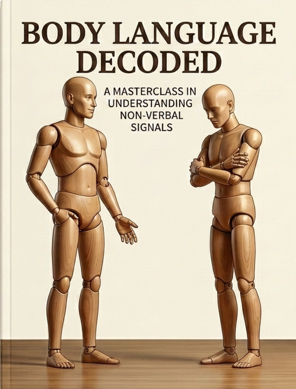
Body Language
Decoded
A visual guide to what your body says when your mouth isn't talking. Posture, hands, face, gaze. What confident looks like head-to-toe, and how to read other people in real time.
- Arms uncrossed, hands visible
- Weight balanced on both feet
- Shoulders relaxed and down
- Chest open, spine upright
- Eye contact present
- Arms crossed as barrier
- Weight on one foot (exit-ready)
- Shoulders raised toward neck
- Chest caved slightly forward
- Eye contact avoided
How to Use This Guide
This guide is visual first. Every concept has an illustration, and you don't need to read this cover to cover. You flip to the section that's relevant right now. For example, nervous before a job interview? Go to Chapter 3. Trying to figure out if someone is actually interested in what you're saying? Chapter 5. Not sure what your own default posture is broadcasting? Start with Chapter 2.
What Body Language Actually Is
Spoiler: There is no magic code to read people's minds 100%, but body language tells a lot of the story.
The Basics
You already read body language constantly. You just do it below the level of conscious thought. You know within seconds of entering a room whether people are relaxed or tense. You know when someone's smile doesn't match their eyes. You know when a conversation is about to end before anyone says anything. This guide makes that unconscious reading explicit.
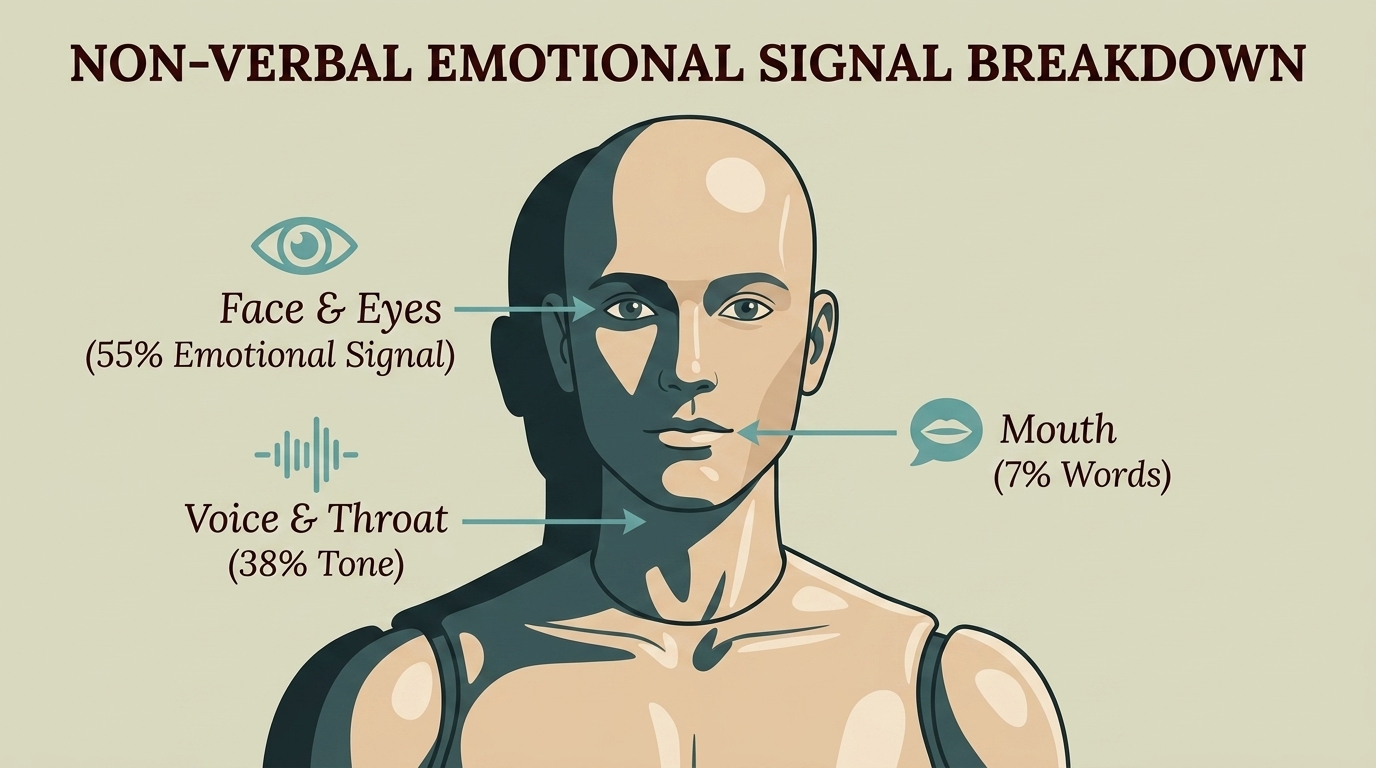
Understand that the words we say absolutely matter, however when body language and words contradict each other, people trust the body over words.
Open vs. Closed: The Most Important Distinctions
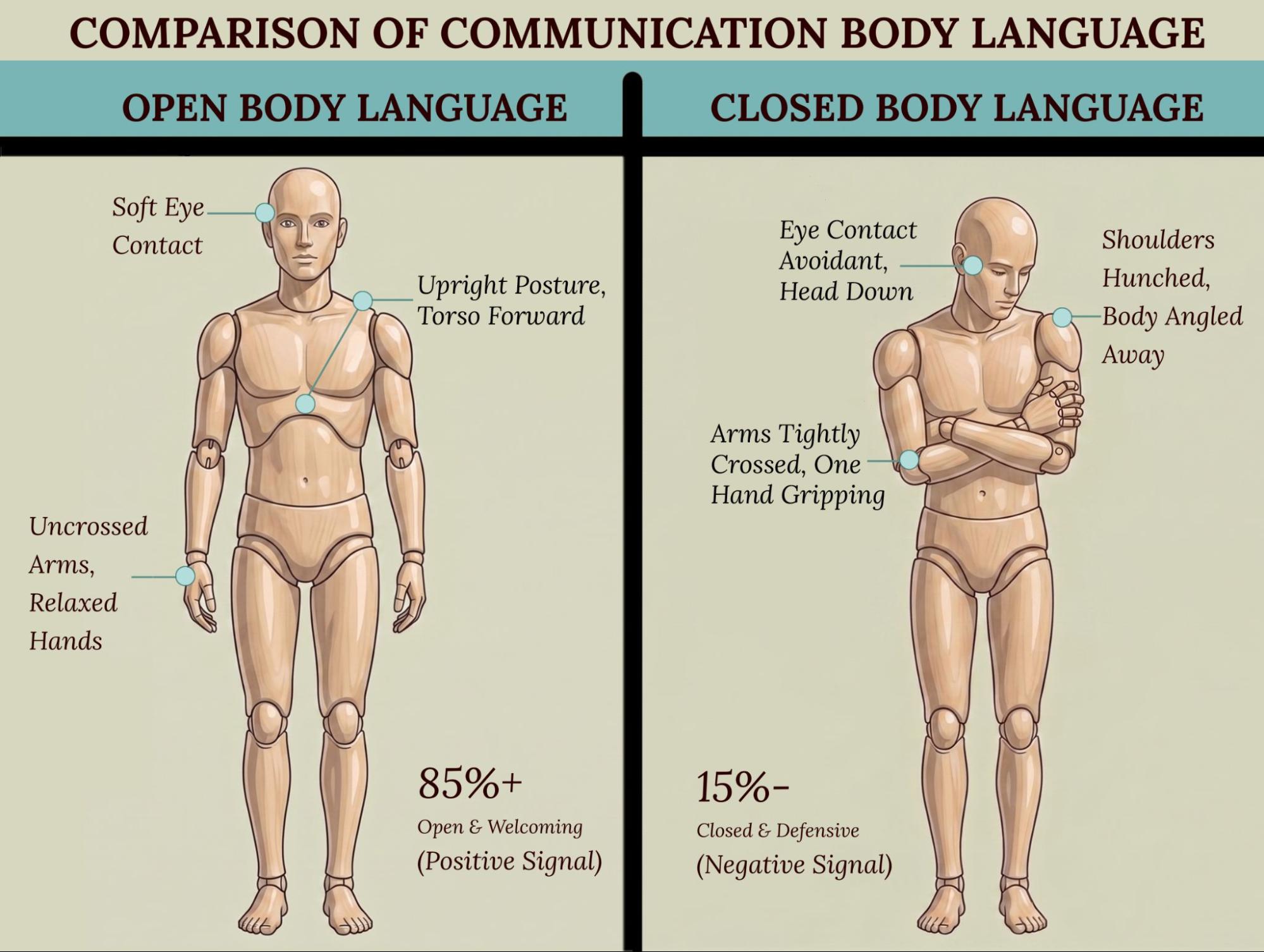
Every piece of body language you'll learn in this guide traces back to one fundamental question: "Am I safe here or not?"
Clusters, Not Single Signals
One crossed arm means nothing. Crossed arms plus angled-away torso plus minimal eye contact plus short clipped answers tells you something. Body language is a pattern language. Single signals get misread constantly. Clusters of consistent signals are much more reliable.
The other context rule is baseline. If someone always crosses their arms when thinking, arms crossed means they're thinking. If they sit with arms open 90% of the time and suddenly cross them the moment you bring up a topic, that's a shift worth noticing.
Posture. What You're Already Broadcasting
Posture is the first thing people clock before you speak and even before you make eye contact. It's your social status signal, visible from across the room.
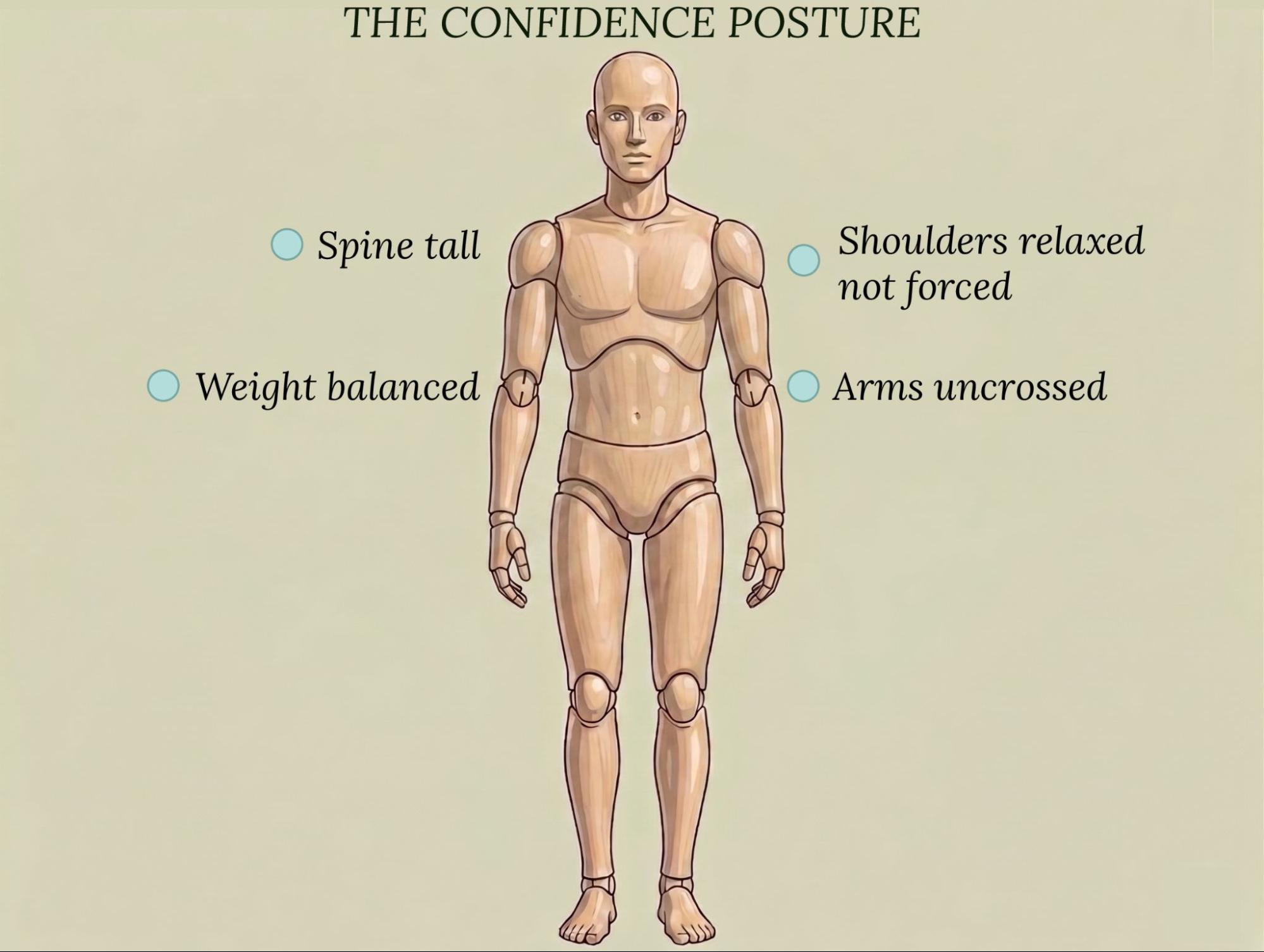
Research by Amy Cuddy and colleagues (with some contested elements, but the core posture findings hold up in replication) shows that expansive, upright postures are read as confident, competent, and trustworthy. Contracted, collapsed postures read as submissive, anxious, or disengaged.
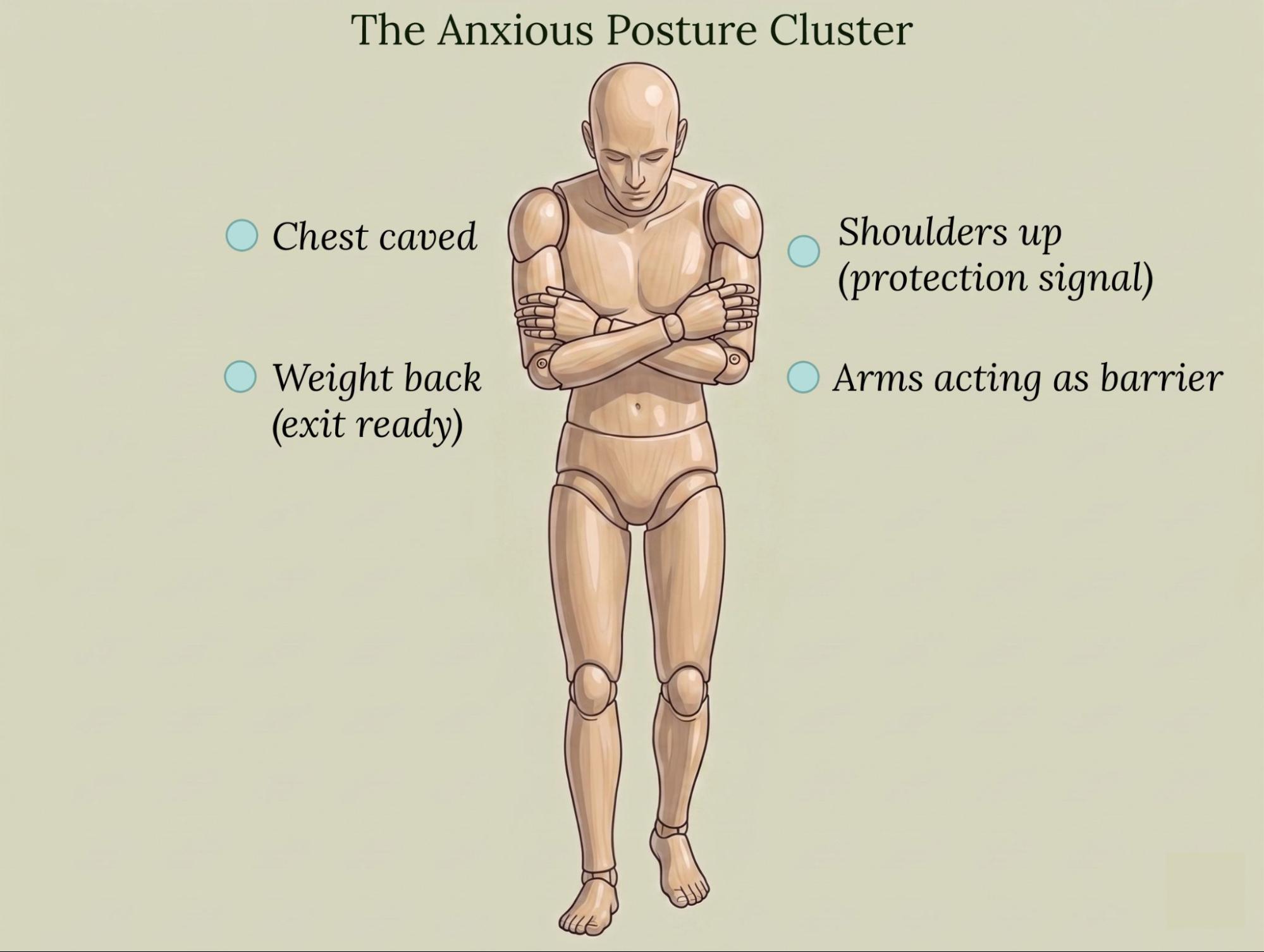
Anxiety in the body looks specific and any of these postures give it away. These are literally submissive signals inherited from primate social behavior and your body is literally trying to make itself look smaller.
Many people do some version of this without realizing it and the majority of people with social anxiety tend to do it. The cruel irony is that the body language of anxiety reads as low-status to others, which tends to produce less positive social responses, which confirms the anxiety and encourages the cycle to continue.
The Sitting Posture Problem
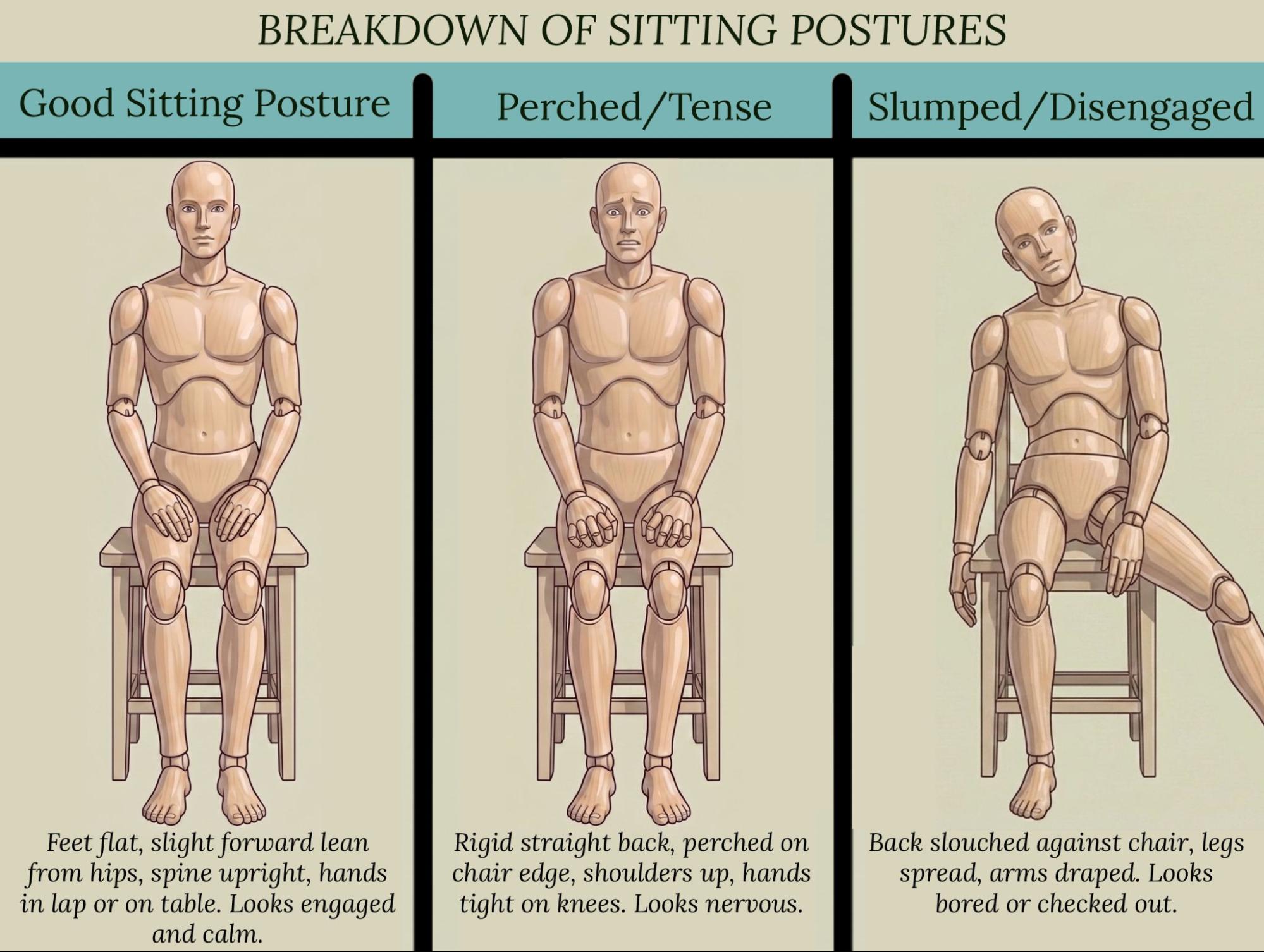
Sitting introduces different challenges. The last one on the right is one of the worst sitting postures for social perception. It may get interpreted as bored or arrogant, overwhelmed or defeated. The middle one is not good either. Perched on the front edge of the seat with a rigid back reads as terrified.
The solid winner here is the left one. Keep both feet on the floor, slight forward lean from the hips (not from the lower back), spine supported but not rigid, hands in lap or loosely on the table. This posture mirrors interest and takes up appropriate space.
One Adjustment That Changes Everything
If you do nothing else from this chapter: lower your shoulders right now as they are probably higher than you think. Most people carry chronic shoulder tension and don't notice it until someone points it out. Shoulders at ear/raised level are a visible anxiety signal. Rolled back and down instantly shifts how you read. It's worth practicing until it's default behavior.
The Triangle Method and Eye Contact
Where you look is as important as how you look. This chapter is the detailed companion to the Triangle Method Poster.
The Gaze Zones
Where you direct your gaze sends specific signals. Research on gaze behavior identifies three primary zones in face-to-face interaction:
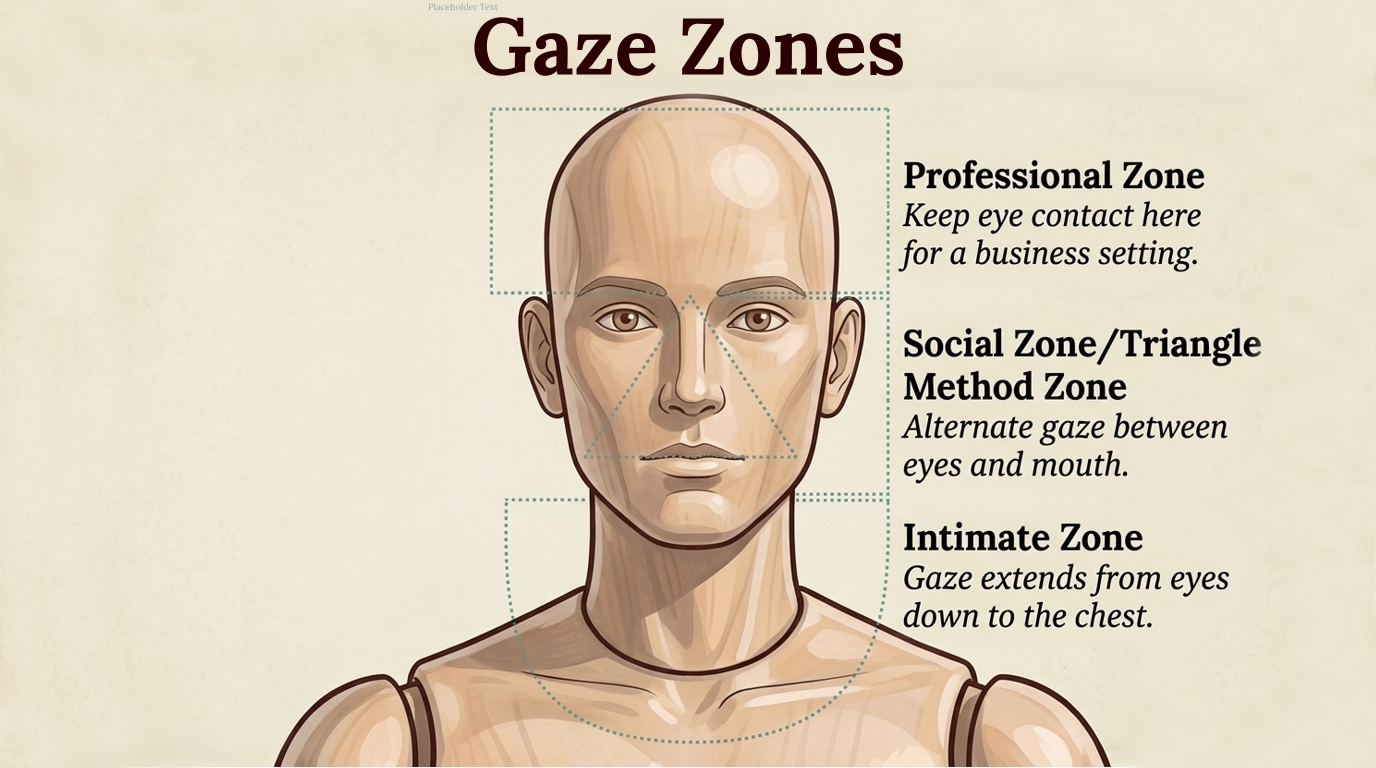
Social zone: Eyes to mouth — The zone most natural for friendly conversation. Signals warmth and engagement without intensity.
Intimate zone: Eyes to chest — Only appropriate in actual intimate or close personal contexts. Using this zone with strangers or colleagues reads as intrusive.
The Triangle Method
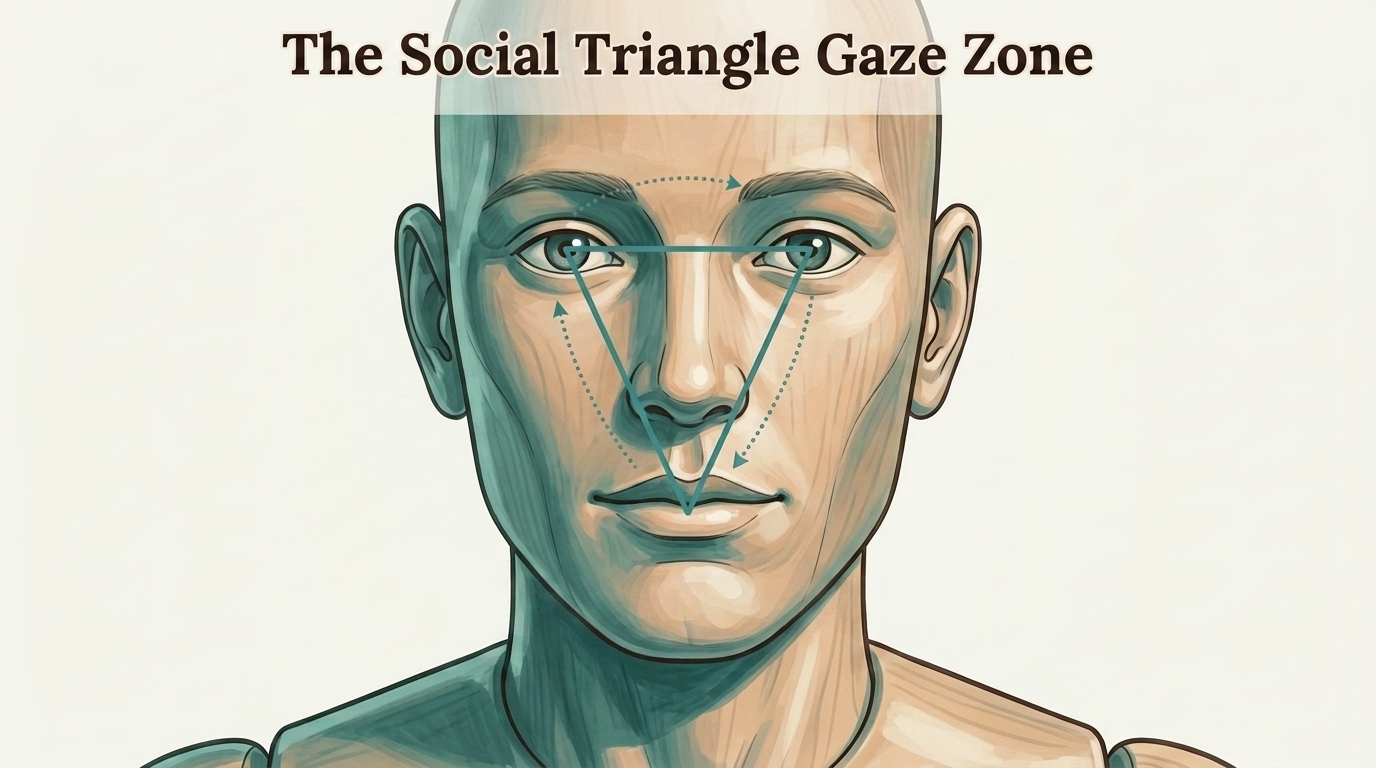
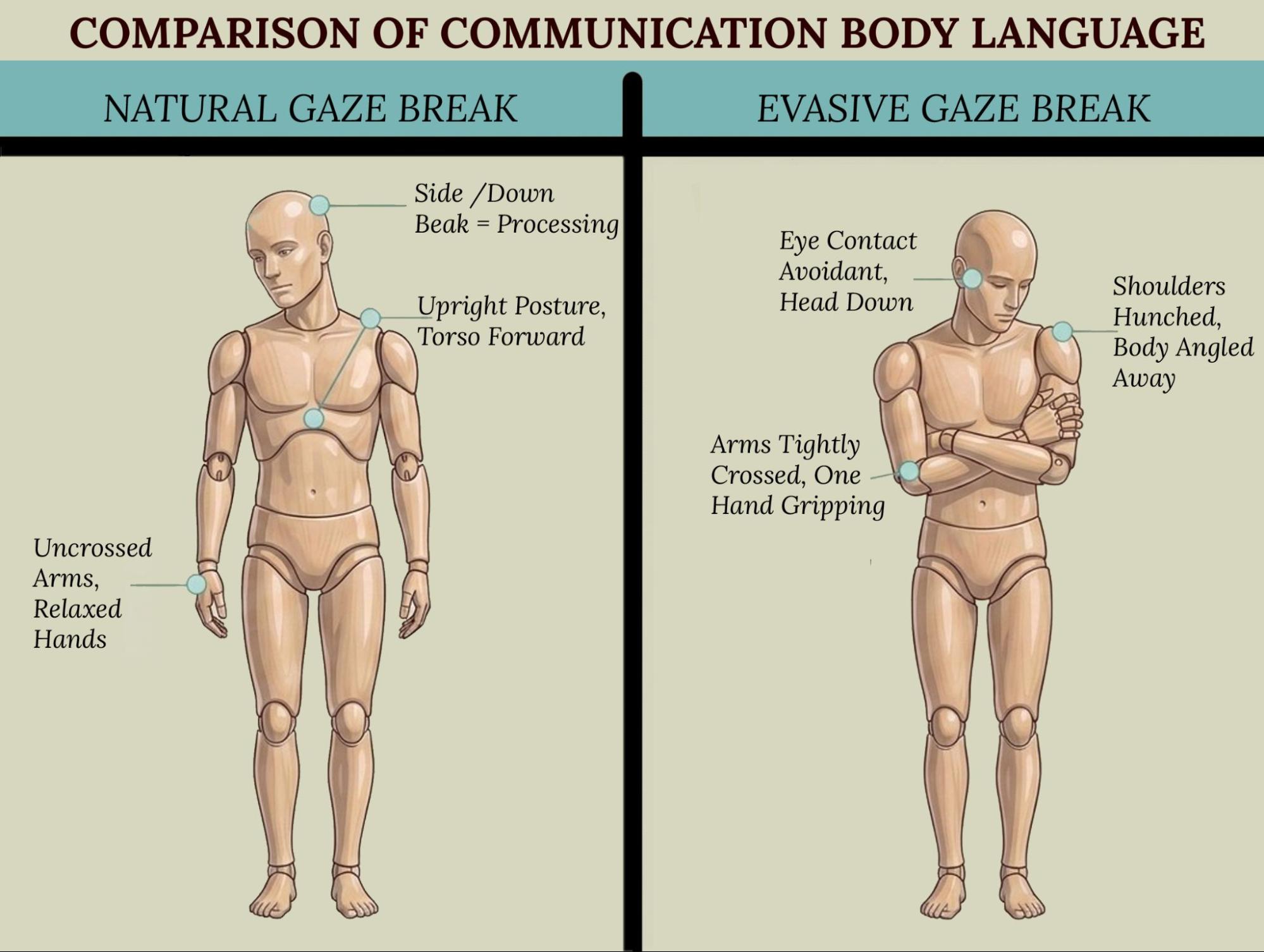
The movement is subtle. Micro-shifts, not scanning. You're not visibly darting your eyes around. You're creating the natural gaze variation that comfortable people use automatically.
The 50/70 Rule, Visualized
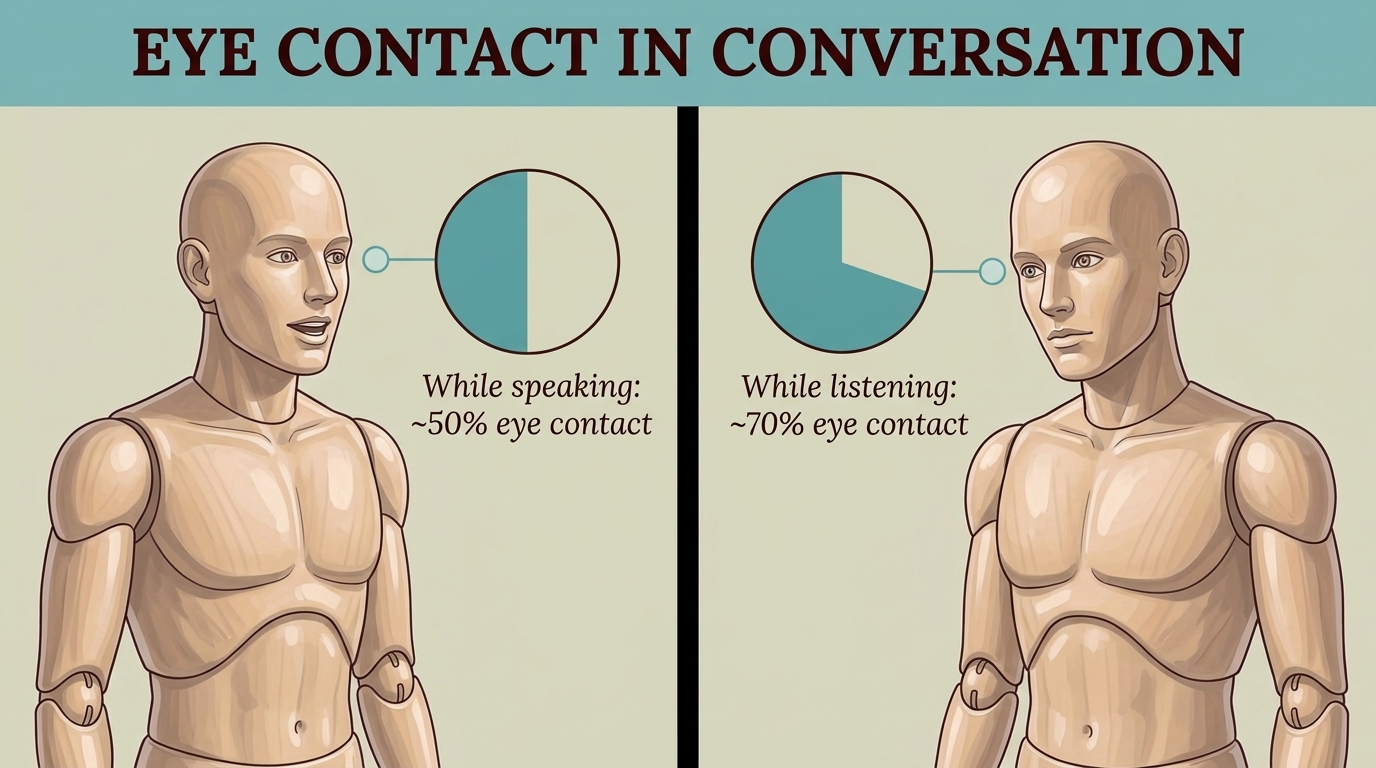
Natural Breaks vs. Evasive Breaks
Hands and Arms
Your hands are one of the most expressive and most anxiety-revealing parts of your body. Here's what they're saying.
Hands are disproportionately important in social perception. Research by Dr. Vanessa Van Edwards found that TED speakers who used more hand gestures during their talks were rated significantly higher on warmth and competence by audiences, before content was even analyzed. Hands do matter.
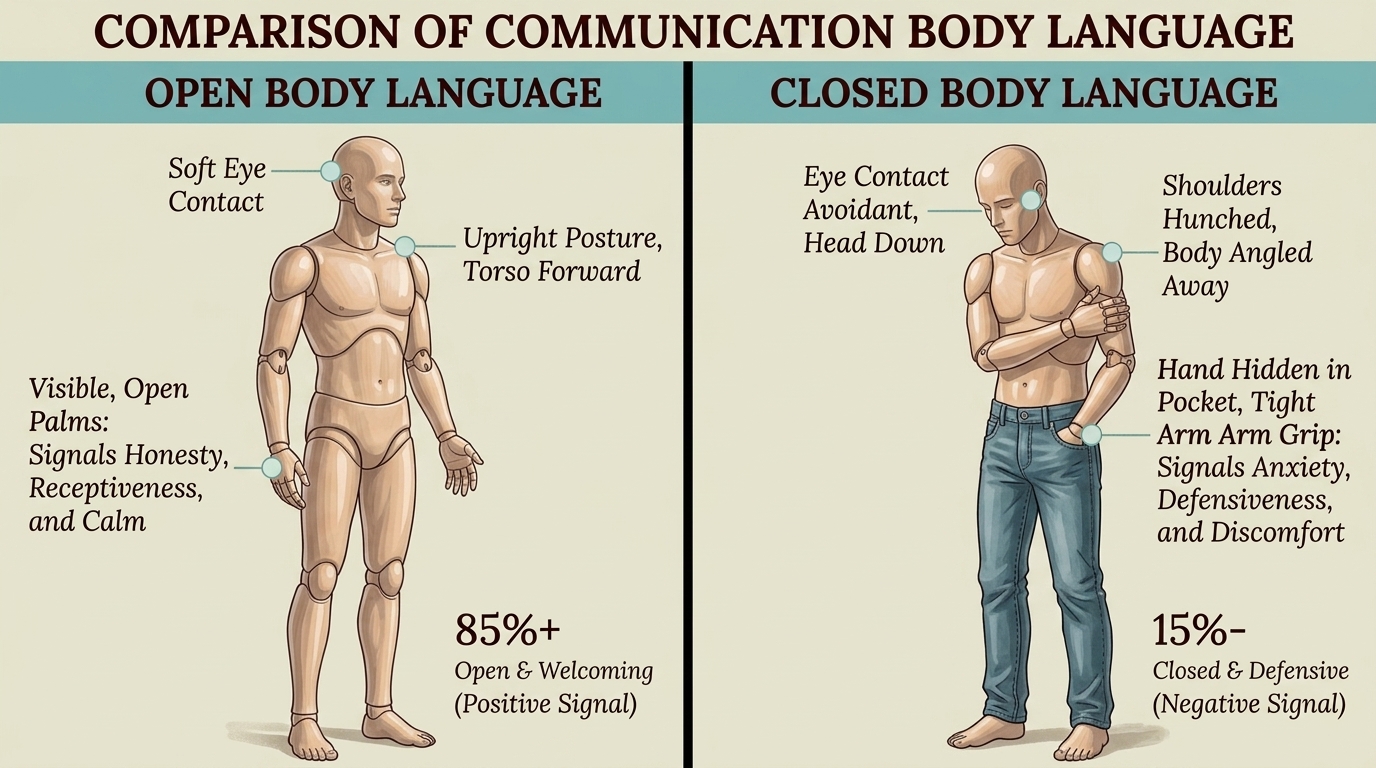
The Arms-Crossed Myth
Arms crossed does not automatically mean defensive or closed off. People may be crossing their arms because they're cold, comfortable, thinking hard, or just don't know what to do with their hands. The signal only means something in context.
With that said, if you're in a conversation where you want to signal openness and engagement, crossed arms work against you. The other person can't read your intent so they may read the signal negatively. Uncrossing is worth doing even if you don't feel defensive.
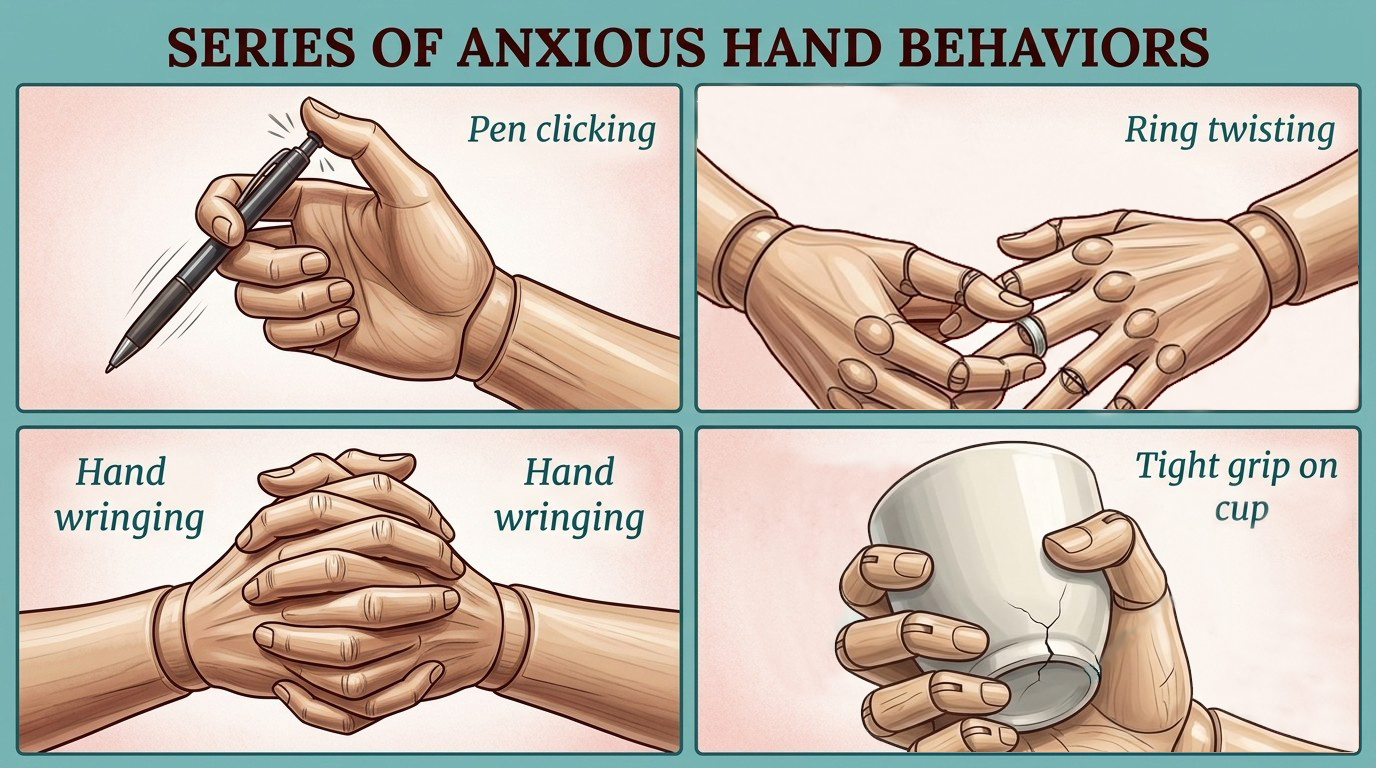
Anxiety Signals in the Hands
Confident Hand Positions
If you don't know what to do with your hands, here are actual positions that work:
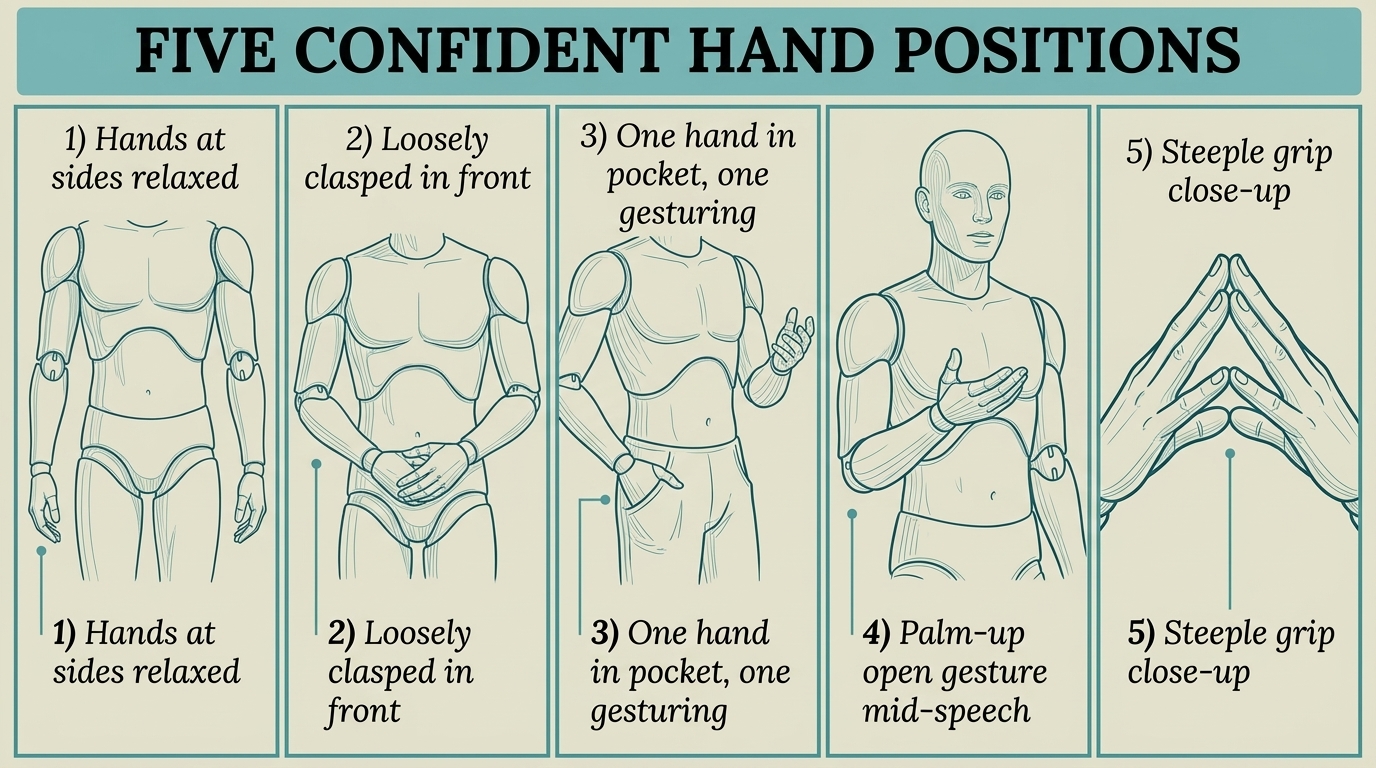
- Hands at sides, relaxed. Difficult if you're anxious but the most neutral signal.
- Hands loosely clasped in front (not a death grip). Works when standing still.
- One hand in pocket, one visible and gesturing. Casual, relaxed. Note that the moving hand is doing enough work to override a concealment concern as mentioned in a previous section.
- Palms open and facing slightly upward when making a point. Signals honesty and openness.
- Steeple grip: fingertips touching, palms apart. Signals confidence and authority. Used a lot by people in high-status roles.
Gesturing While Speaking
Natural gesturing amplifies your words and makes you more persuasive. Forced gestures look worse than no gestures. If gesturing isn't natural for you right now, don't add it. Focus on the posture and gaze work first. The gestures tend to emerge once you're more comfortable.
The one exception is the palm-up gesture when making a point. This is a concrete, learnable signal that reads as open and honest rather than directive or demanding. Practice it and it will feel natural within a few weeks.
Reading Whether People Are Actually Engaged
This is the chapter about reading other people. Here, you'll learn to stop misreading situations.
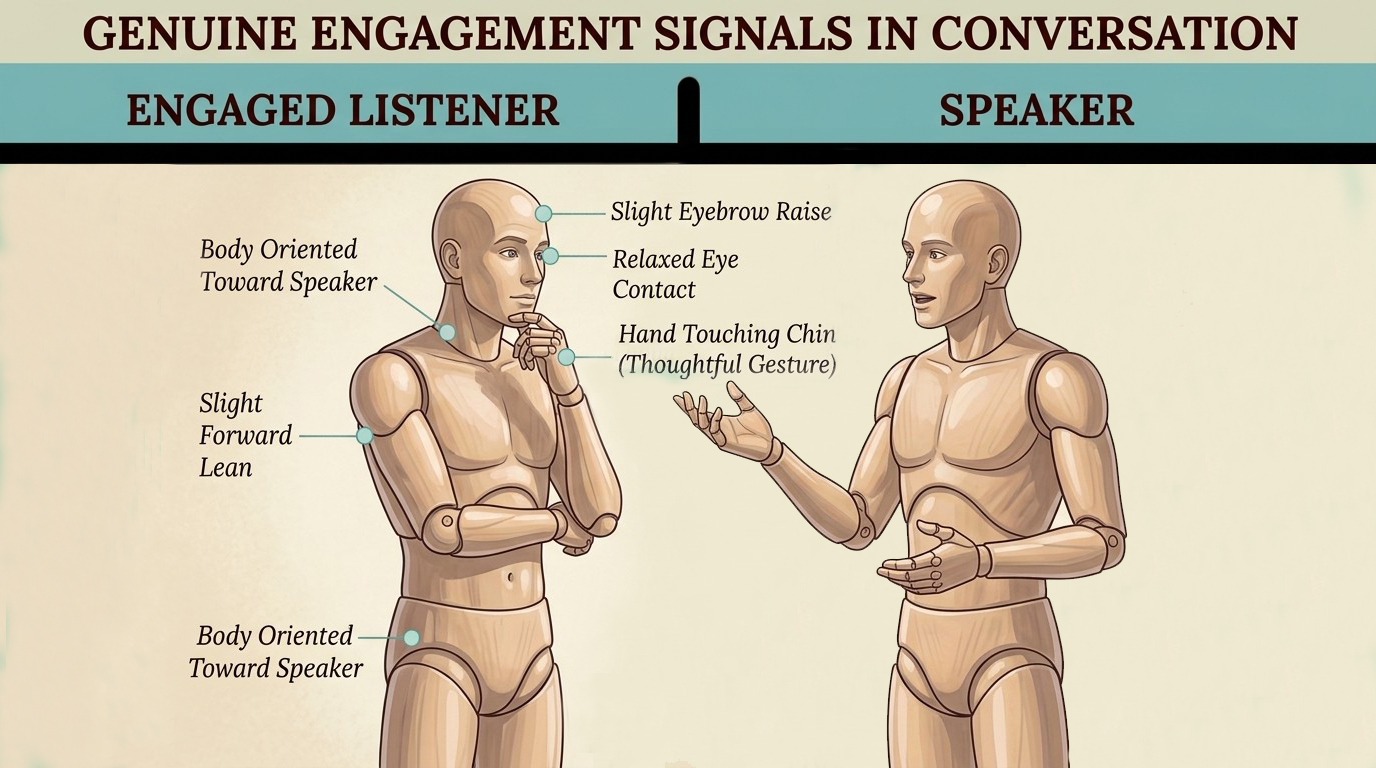
Genuine Interest Signals
When someone is genuinely engaged in a conversation, the cluster looks like this:
Disengagement Signals
Disengagement is often more subtle than people expect. The person may still be mechanically doing the right things by still nodding and making sounds of acknowledgment. However, they may be disengaged if their feet are pointed toward the exit, their eyes are drifting, their responses are getting shorter and more vague, they've checked their phone twice, or all of the above.
The feet are one of the most reliable disengagement signals. We control our face and our hands consciously in social situations. If someone's feet are pointed at the door during a conversation, part of them subconsciously shows that they want to leave. It's not necessarily because of anything you did as they might just need to go.
| Signal | What it reads as |
|---|---|
| Feet pointing toward exit | They're ready to leave or end the conversation |
| Micro-nods (very fast, mechanical) | Polite acknowledgment, not actual engagement |
| Eyes drifting to the side or over your shoulder | Scanning the room, attention elsewhere |
| Responses shortening to 'yeah', 'uh huh', 'sure' | Conversation is winding down for them |
| Body turning slightly away | Creating distance, preparing to exit |
| Phone appears | Whatever is on the phone is competing with you and winning |
Nervous vs. Bored vs. Annoyed
These are the three states that get misread constantly:
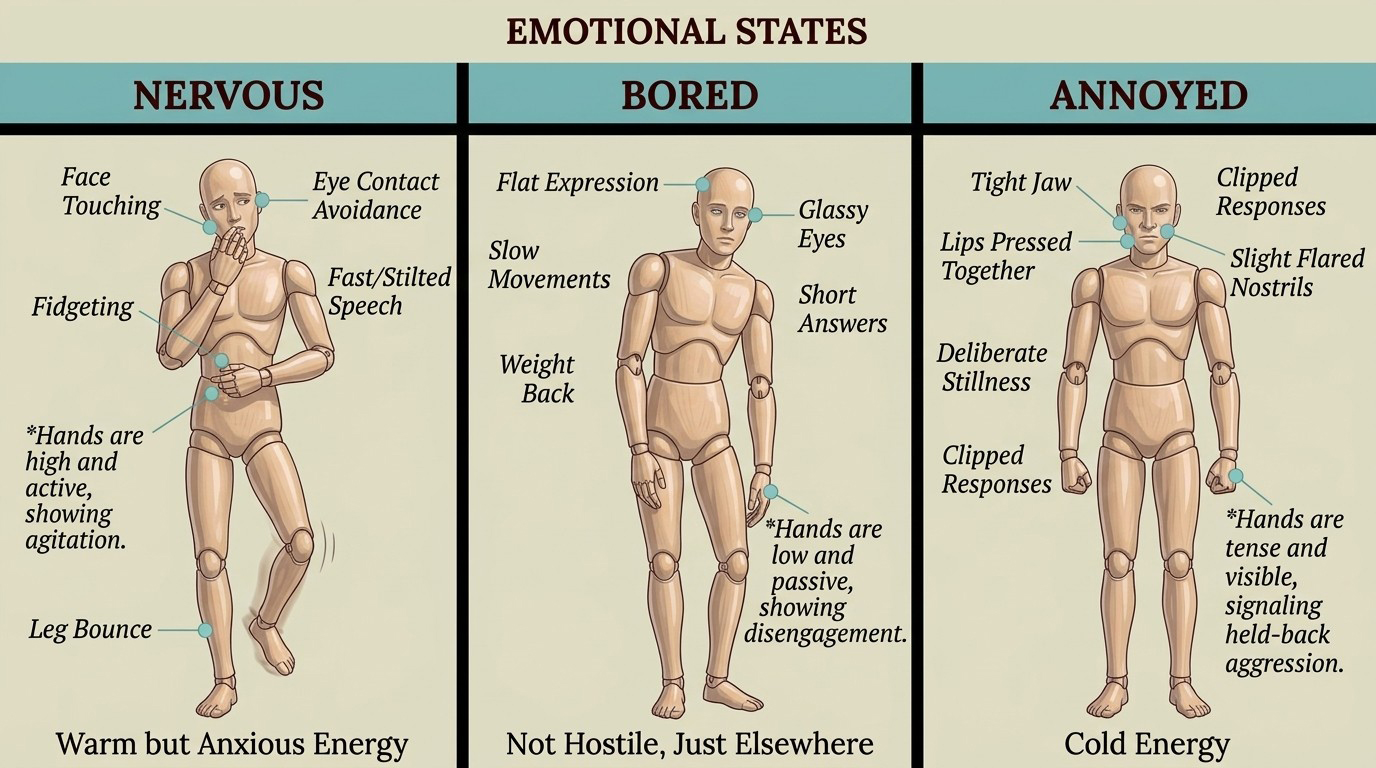
Bored: slow movements, few facial expressions, flat tone, short answers, weight shifted back, eyes glazing. Not hostile. Just not engaged.
Annoyed: tight jaw, compressed lips (pressed together), flared nostrils, clipped short responses, sighing, deliberate stillness (the opposite of fidgeting). This is the one you want to catch early.
The Mirroring Signal
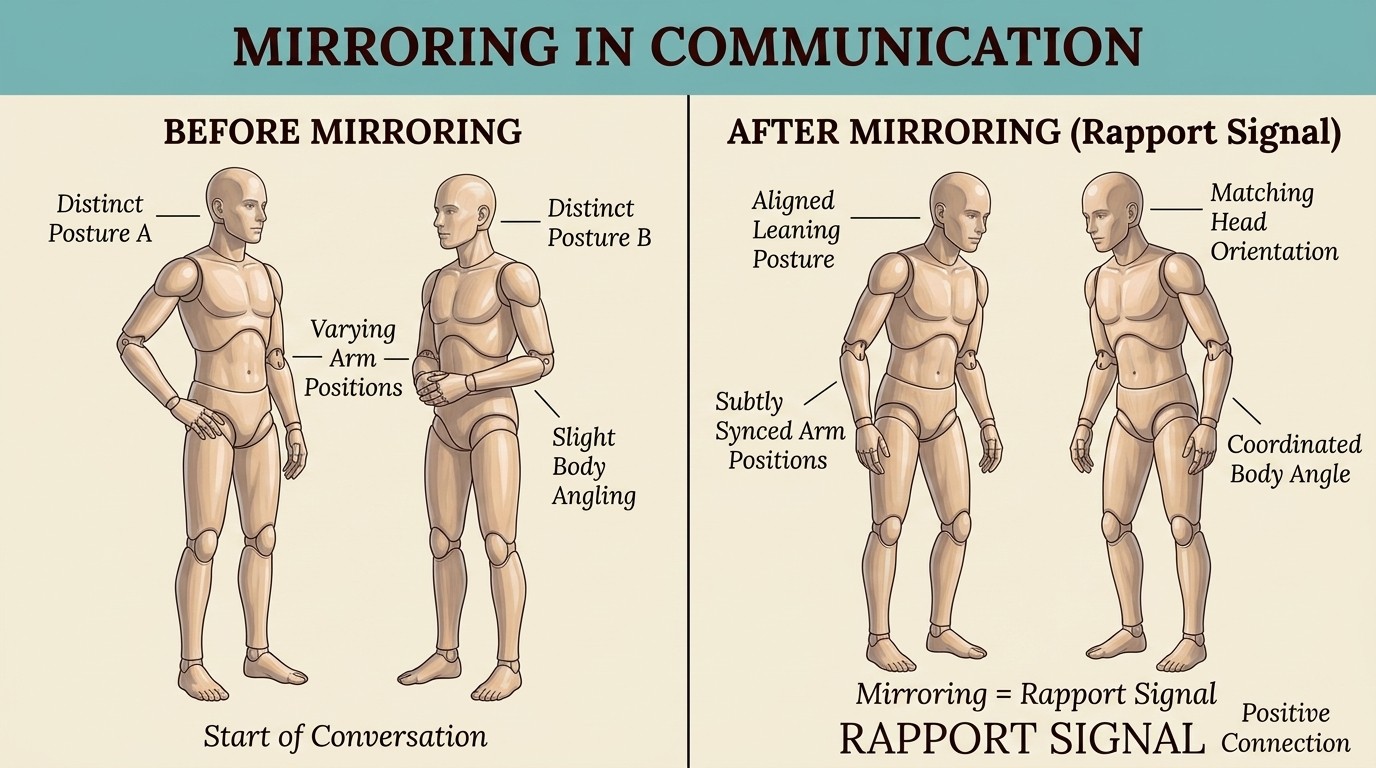
Mirroring is when someone unconsciously copies your posture, gestures, or timing. It happens automatically when people feel rapport. If you cross your legs and they cross theirs a few seconds later, if you lean back and they lean back, mirroring is happening. It's one of the clearest signals of genuine connection available.
You can also use mirroring deliberately to build rapport, but it's not supposed to be in an obvious "copy everything they do" way.
The Face
The face is where people look first and where the most gets given away.
The Duchenne Smile
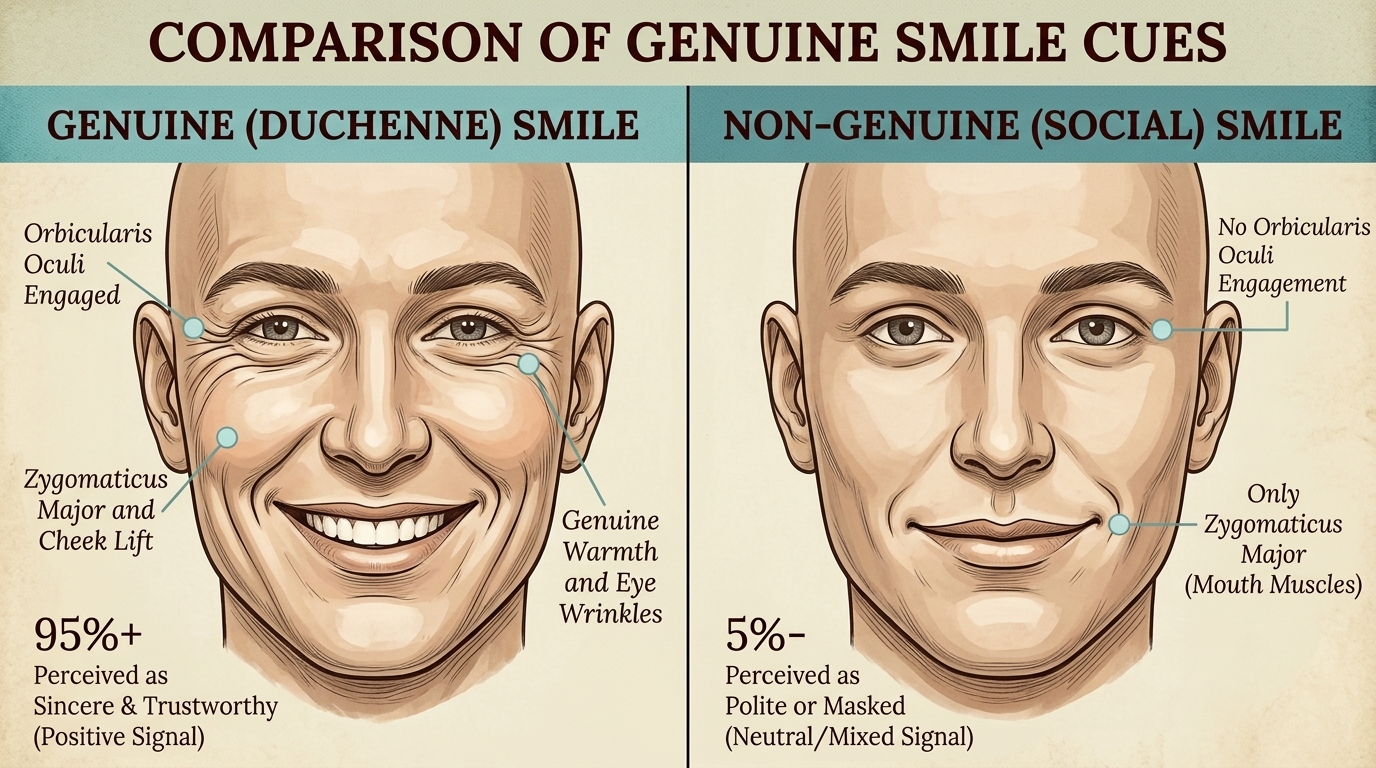
This matters because social smiling is necessary to build trust with people. If you want your smile to read as warm and real, it helps to actually feel something warm toward the person you're talking to. It shows interest, curiosity, and affection. The genuine version follows.
Micro-Expressions
Paul Ekman's research identified seven universal facial expressions that flash across the face in as little as 1/25th of a second before conscious control takes over — happiness, sadness, fear, anger, disgust, contempt, and surprise. These micro-expressions leak genuine emotion before the social mask reasserts itself.
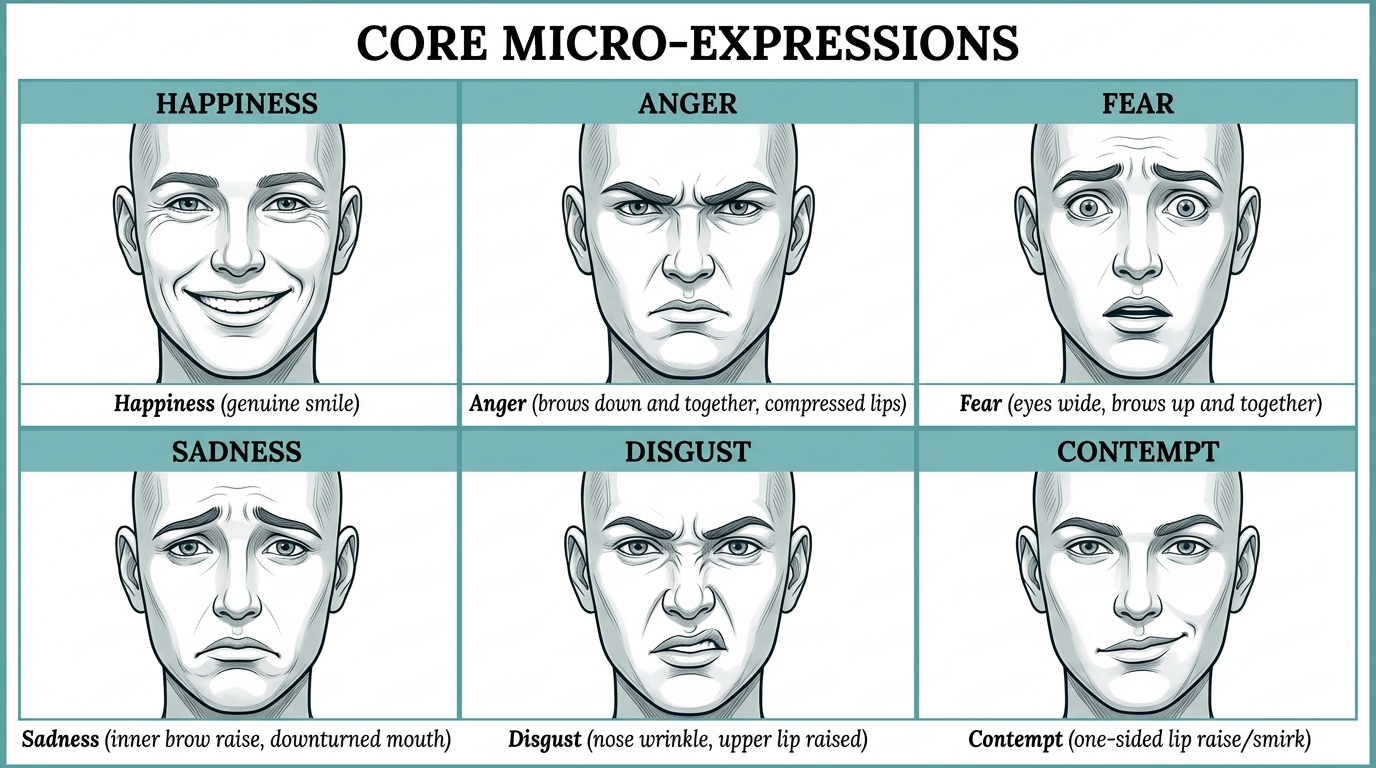
You probably already read some of these unconsciously. That feeling of "something seemed off about that" is often a micro-expression you caught below the level of awareness. You don't need to learn to read them with clinical precision. You just need to know they exist and that your gut response to them is often accurate.
The Contempt Signal
One expression worth learning to read specifically is contempt. It's the one asymmetrical expression in Ekman's set. It's a slight raise of one corner of the mouth called a micro-sneer. It's the expression of feeling superior to someone. Gottman's relationship research found contempt to be the single strongest predictor of relationship breakdown, romantic or professional. If you see this expression in a conversation, something is off. If you find yourself making it, it's something worth examining and doing some self reflection on why you may be doing it.
The Full Picture
Putting it all together. What confidence and nervousness look like head-to-toe.
There isn't any single signal alone that will show you as a confident person. It's always a combination of different things.
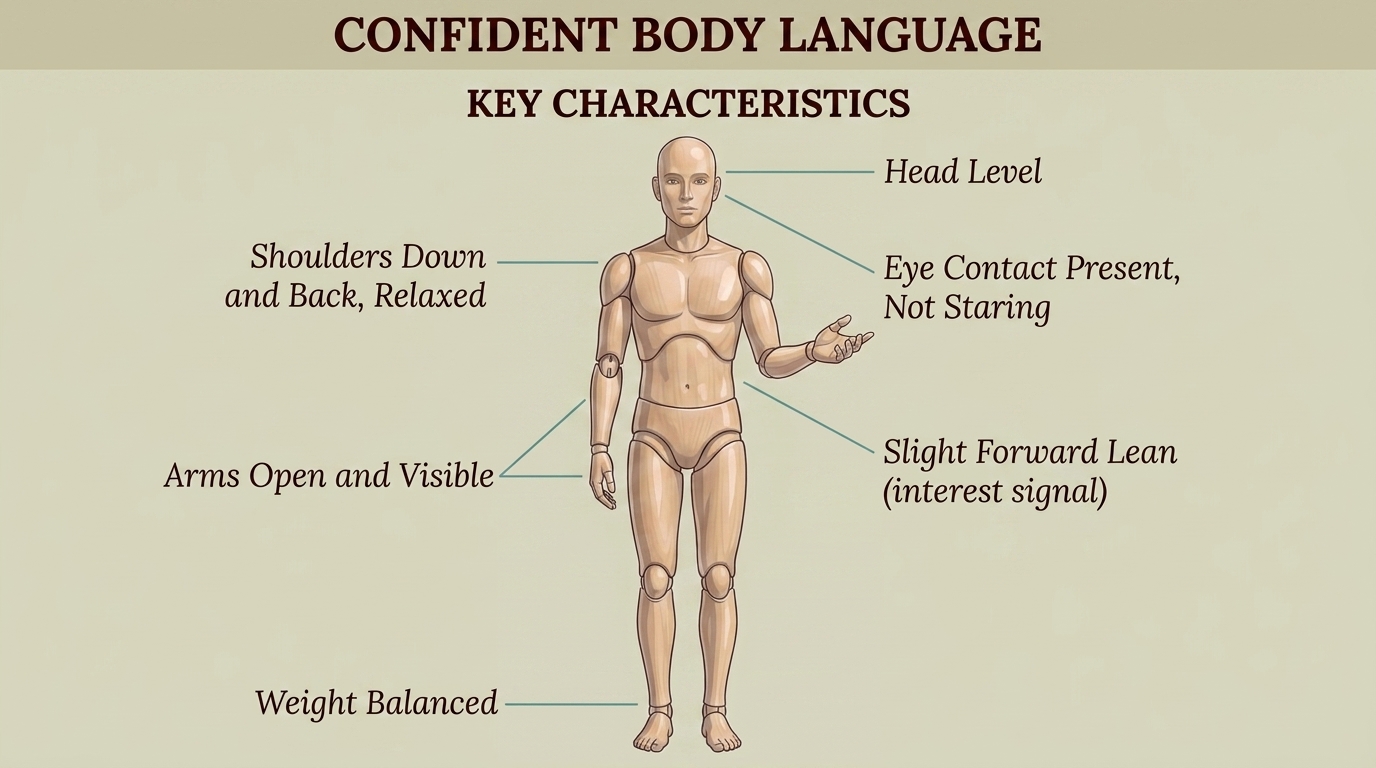
| Signal | What it reads as |
|---|---|
| Weight balanced on both feet | Grounded and not preparing to flee. |
| Shoulders down and back, relaxed | Not in threat response and chest open. |
| Arms uncrossed, hands visible | Transparent, non-aggressive, and approachable. |
| Slight forward lean | Interest and invested in the conversation. |
| Eye contact: relaxed, present, cycling | Engaged, but not staring. Using the Triangle zone. |
| Head level or slightly tilted | Attentive. A slight head tilt signals listening. |
| Gestures while speaking | Natural movement. Increases perceived warmth. |
| Breathing visible and relaxed | Parasympathetic state shows the nervous system is calm. |
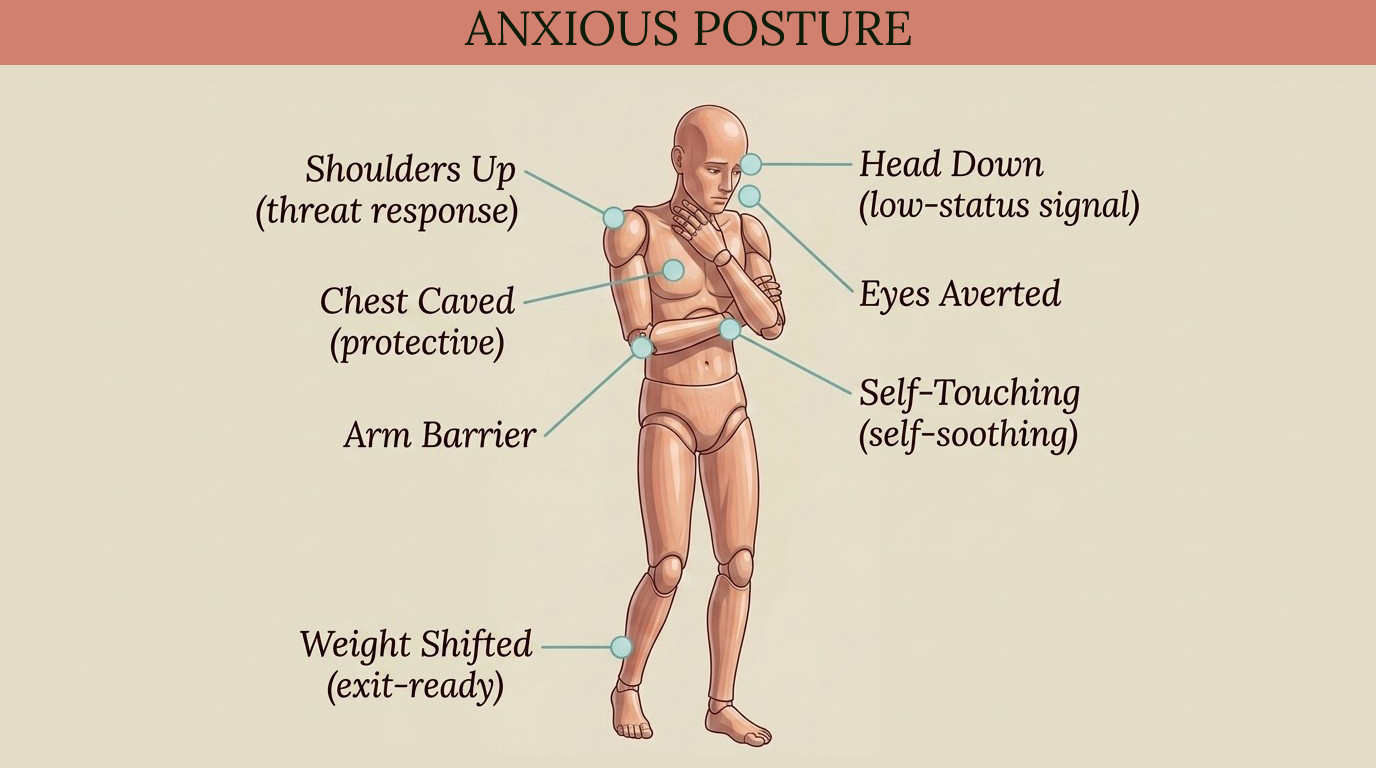
| Signal | What it reads as |
|---|---|
| Shoulders raised toward ears | Threat response. Body protecting the neck. |
| Chest caved forward | Protective/shrinking. |
| Arms crossed or forming a barrier | Closed off which may or may not be intentional. |
| Weight on one foot | Prepared to leave or not fully committed to being there. |
| Head tilted down | Low-status signal. Submission. |
| Eye contact avoidance | Either threat response or overwhelm. |
| Face touching, fidgeting | Self-soothing. Anxiety shows. |
The Gap Between Inside and Outside
The good news is you can feel terrified and still display confident body language. It takes conscious effort, and may feel fake at first, but what you're actually doing is giving your nervous system a different set of inputs to work with. Research shows that adopting upright, open posture actually shifts internal state somewhat. It won't be a complete shift, but it's enough to matter and make a positive difference.
To start your shift, start with something easy first: Keep your shoulders down and feet flat on the floor, roughly hip-width apart (weight balanced). Also, keep the arms uncrossed. Three small corrections before you walk into a difficult situation. You will feel the difference.
Space. How Close Is Too Close.
Proxemics is the study of how people use physical space in social interaction. Getting this wrong is invisible but immediately felt.
The Four Zones
Anthropologist Edward Hall defined four spatial zones in 1966 that hold up well across most Western social contexts:
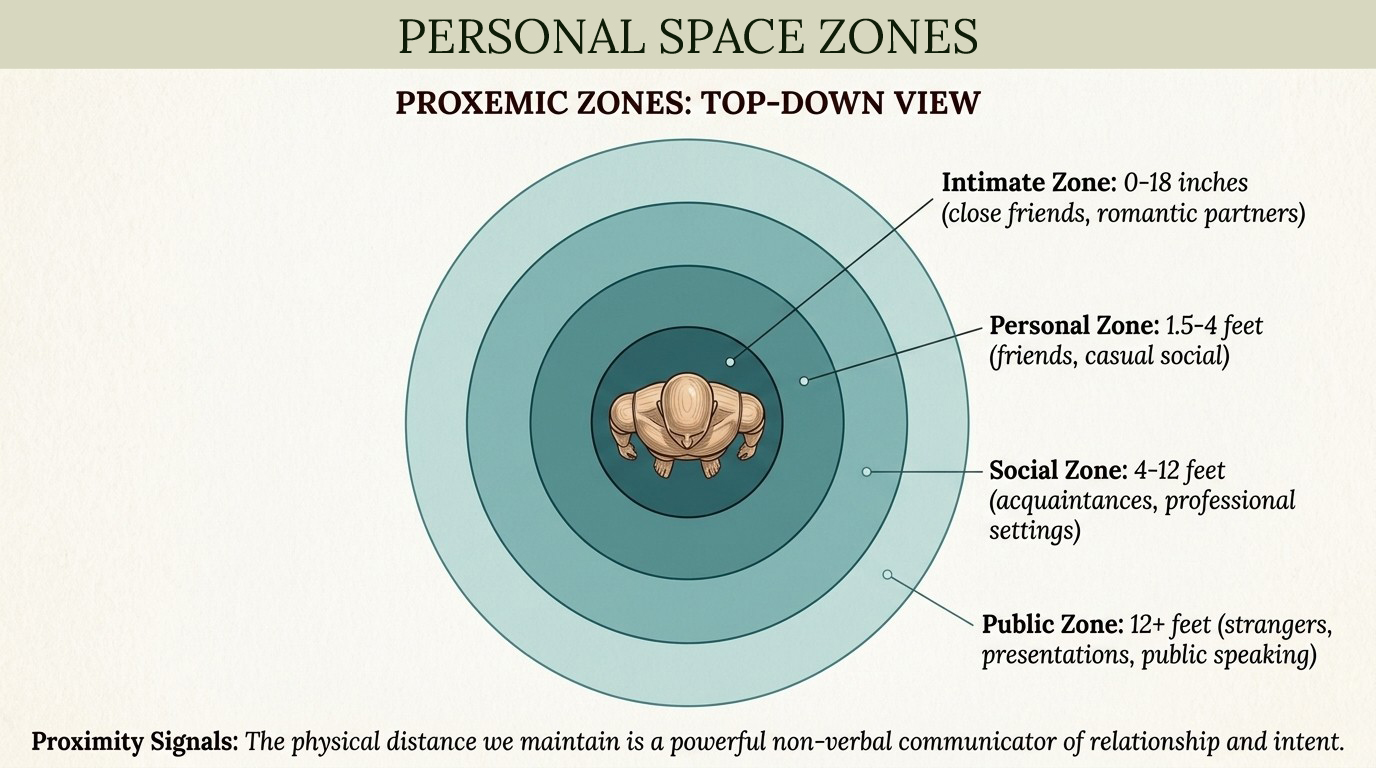
Getting space wrong is one of those things people can't always name but definitely experience. If someone is drifting backward in a conversation, you're probably in their personal zone and they're recalibrating. Don't follow them if they do this.
Cultural Variation
Hall's zones are based on Western (primarily American) norms. They vary significantly across cultures. Mediterranean, Middle Eastern, and Latin American cultures typically use closer proximity as normal conversational distance. East Asian cultures often use slightly more distance. Northern European cultures lean wider.
If you're interacting across cultural backgrounds, take your cue from the other person. If they step closer, they're comfortable with that distance. If they step back, respect it. Let them set the zone.
Body Language Cheat Sheet
Print this page. Put it somewhere useful.
| Signal | What it reads as |
|---|---|
| Shoulders down and back | Calm, confident, not in threat response |
| Arms uncrossed, hands visible | Open, transparent, approachable |
| Weight balanced on both feet | Grounded, present |
| Slight forward lean | Interest, investment |
| Slow head nod | Active listening, genuine engagement |
| Eye contact in the Triangle zone | Warm, engaged, not aggressive |
| Open palm gestures | Honest, non-directive |
| Mirroring the other person | Rapport, connection, (often unconscious) |
| Duchenne smile (eye crinkle) | Genuine warmth, not just social politeness |
| Head slight tilt when listening | Attention, care |
| Signal | What it reads as |
|---|---|
| Feet pointing to the exit | Ready to leave the conversation |
| Rapid machine-gun nodding | Polite, not actually engaged |
| Arms tightly crossed + torso turned | Discomfort or withdrawal (read in cluster) |
| Face touching increases | Anxiety or stress rising |
| Tight jaw, compressed lips | Annoyance or suppressed response |
| Eyes drifting over your shoulder | Distracted, conversation losing them |
| One-sided lip raise (contempt) | Feeling superior, dismissive |
| Shoulder shrug (single or double) | Uncertainty or lack of commitment |
That's the Method
As you know by now, body language is an integral part of communication that has always been there, but there's been no user manual for it. This guide was meant to fill that gap for those that have trouble with their body language and provide a method for improving it for positive outcomes. You can start improving now with just some simple steps daily. For starters, remember to keep shoulders down, arms uncrossed, eye contact present and everything else will build from there. Know that you don't have to nail all of this at once.
The Quiet Person's Guide covers the psychology behind why this is hard for your specific brain. The Triangle Method Poster gives you the one-page quick reference for eye contact. This guide is the visual vocabulary. Together they're the full method/system. Practicing this method and applying what you learn here is a great investment in yourself.
"What you do is louder than what you say."
— GazeIQ