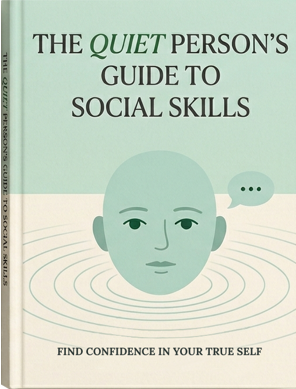
The Quiet Person's Guide
to Social Skills
Everything neurotypicals figured out by accident. For the quiet ones, the anxious ones, and the late bloomers. Science-backed, plain-spoken, no fluff.
How to Use This Guide
This guide is not a self-help lecture. It does not assume you are broken, defective, or socially hopeless. It assumes something far simpler: nobody actually sat down and explained the rules to you.
Neurotypical people absorb social skills the way they absorb language; gradually, through thousands of micro-interactions, without ever consciously studying them. If your brain works differently, or if anxiety, neurodivergence, or a difficult environment got in the way of that osmosis, you may have arrived at adulthood feeling like everyone else got a manual you never received.
This is that manual.
You do not have to read it cover to cover. Skip to the chapters that feel most urgent. Return to the earlier ones when you're ready. Use the exercises when you want to practice, and skip them when you just want information. The goal is not to transform you into a social butterfly; it's to give you options and understanding so that social situations feel less like a foreign concept and more like something you can navigate on your own terms.
You Didn't Miss the Class, Nobody Taught This
The first step to learning social skills as an adult is understanding why they feel so hard to begin with.
The Invisible Curriculum
Imagine a school where the most important subjects are never written on any syllabus. No lessons on how to hold eye contact comfortably, when to speak and when to listen, how to enter a group conversation, what to do when you blush in front of your entire team during a presentation, or how to read whether someone actually wants to keep talking. These skills are simply expected to develop… and for most people they do, invisibly, through years of social rehearsal in low-stakes environments.
That process gets interrupted or never quite starts for a significant portion of people unfortunately. Social anxiety means your nervous system sounds alarm bells in situations that feel dangerous even when they are not. ADHD makes it harder to catch the subtle timing cues of conversation. Autism means the unspoken rules of neurotypical interaction simply do not auto-install the way they do for others. Introversion, bullying, social isolation, or a difficult childhood can each leave gaps in a person's social foundation that no one ever helped them fill.
The result is an adult who can write code, manage projects, raise children, or run businesses, but who still dreads walking into a party alone or making eye contact with a stranger, and feels vaguely ashamed that something so simple can feel so hard.
Here is what that shame misses: social competence is a skill. Skills can be learned at any age. The fact that you are learning it consciously, deliberately, as an adult, instead of absorbing it unconsciously as a child, does not make you deficient, it makes you intentional.
"People are too immersed in their own lives to be scrutinizing you the way you think they are."
— r/socialskills community thread
The Spotlight Effect: Why It Feels Like Everyone Is Watching
One of the most universal experiences of social anxiety is the conviction that other people are paying close attention to your every move. You spill something at a meeting and feel certain that everyone clocked it. You stumble slightly on a word and replay it for hours. You blush and are convinced the whole room noticed.
Research by psychologists Thomas Gilovich and Kenneth Savitsky documented what they called the Spotlight Effect — the human tendency to dramatically overestimate how much other people notice and evaluate our behavior. In their studies, participants predicted that roughly twice as many observers noticed something embarrassing about them than actually did. The spotlight we feel on ourselves is almost always twice as bright in our imaginations as in reality.
Paired with this is the Illusion of Transparency: the equally common belief that your internal state (your anxiety, your nervousness, your blushing) is far more visible to others than it actually is. You feel like your heart is pounding out of your chest, your cheeks are glowing red, and your hands are visibly shaking while the person across from you sees a person who seems slightly distracted.
Understanding these two phenomena will not instantly dissolve your anxiety, but it gives you something powerful: a factual counter-narrative. When your brain says "everyone can tell," the evidence says they probably cannot tell.
Rethinking What 'Normal' Looks Like
The Reddit user LeoJohnsonsSacrifice put it bluntly: "You're not that special." They meant it as a relief, not an insult. The crushing weight of social anxiety often rests on an inflated belief in our own centrality in other people's minds. When you internalize the truth that most people are far too absorbed in their own internal weather to be cataloguing your social missteps, the stakes of any given interaction drop dramatically.
None of this means you don't matter. It means the social risks feel far larger than they are and that gap between perceived risk and actual risk is exactly where social skills training operates.
Understanding Your Wiring
Social anxiety, introversion, ADHD, and autism each shape social experience in distinct ways. Understanding which forces are at play is the first step to working with them rather than against them.
Social Anxiety: When the Alarm System Misfires
Social anxiety is not shyness, and it is not a character flaw. Rather, it is a pattern in which the brain's threat-detection system, specifically the amygdala, activates in social situations as if they were physically dangerous. The system that would protect you from a predator triggers in response to a conversation with a stranger, a work presentation, or making eye contact with someone on the street.
Physically, this produces real symptoms: elevated heart rate, sweating, blushing, dry mouth, a sudden inability to think clearly. These responses are very real and they are the body doing exactly what it was designed to do in a high-threat situation. The problem is that the threat assessment is miscalibrated.
Social anxiety frequently includes catastrophic thinking: the automatic prediction that the worst possible outcome will occur. Before a presentation your brain runs the calculation: I will forget everything, I will visibly panic, everyone will see, they will judge me as incompetent, I will lose my job. Each step in that chain feels inevitable, even though the actual probability at each stage is small.
The Physical Symptoms: Blushing and Sweating
Blushing is one of the most distressing physical symptoms of social anxiety precisely because it is visible. Unlike a racing heart or tense muscles, it feels like a confession. Research has found that people with social anxiety often overestimate how much they blush and how much others notice it. In practice, observers are generally far less focused on another person's flush than the person experiencing it assumes.
Counterintuitively, one of the most effective strategies for managing blushing is to stop trying to suppress it. The harder you fight against the blush, the more physiological arousal you generate, which typically makes blushing worse. Accepting the blush, and even mentally naming it ("I'm blushing right now and that's okay") tends to reduce the secondary anxiety spiral that amplifies the response.
The same principle applies to sweating. Safety behaviors like trying to hide perspiration, adjusting your clothing, crossing your arms, avoiding movement, draw more attention and consume cognitive resources that could be used for the actual interaction. Over time, consistently facing the situations that provoke sweating and blushing, without using avoidance strategies, reduces the severity of the response through a process called habituation.
Introversion: Energy, Not Fear
Introversion is frequently conflated with social anxiety, but they are different things. Introverts are not afraid of people. They simply find extended social interaction draining rather than energizing. An introvert may be perfectly comfortable at a party for two hours and exhausted by hour three. The same introvert may be excellent at one-on-one conversation, public speaking on topics they know well, or deep collaborative work.
The challenge for introverts is that the default social world is largely designed by and for extroverts: open-plan offices, networking events, group brainstorming, constant availability on messaging platforms. Navigating this world without understanding your own energy requirements leads to chronic social fatigue, which can look and feel a great deal like social anxiety.
The practical solution is energy management: knowing your limits, protecting recovery time, and choosing social situations strategically rather than saying yes to everything and paying the cost in exhaustion and resentment.
ADHD and Social Connection
Adults with ADHD frequently find social interaction challenging in ways that are distinct from anxiety. The core difficulties typically include: interrupting before the other person has finished speaking (not from rudeness but from the rapid pace at which ideas arrive), struggling to maintain attention during conversation especially when the topic does not engage executive function, missing subtle social cues due to attentional differences, and dysregulating emotionally in ways that can feel jarring to others.
The ADHD experience in social situations is often one of sincere effort combined with frustrating inconsistency. Someone with ADHD may have a brilliant, engaged, deeply connecting conversation on Tuesday and seem completely distracted and disinterested in the same person on Wednesday, not because of the relationship but because of where their attentional resources happen to be that day.
Autism and the Neurotypical Social Code
For autistic adults, particularly those who received a late diagnosis or no diagnosis at all, the neurotypical social world can feel genuinely bewildering. The unwritten rules that neurotypical people navigate automatically (the appropriate amount of eye contact, how long to talk about a topic before passing the conversational baton, which questions are too personal, when a smile means genuine warmth versus polite distance) are not instinctive for autistic people. They must be learned explicitly, the way you might learn the grammar of a foreign language.
This is not a deficit of intelligence or empathy. Autistic people frequently have rich inner lives and deep capacity for connection, but the codes through which neurotypical people communicate do not come pre-installed. Harold Reitman's Aspertools offers practical frameworks for understanding and navigating this, and are written with the clarity of a parent who went looking for genuinely useful tools rather than clinical theory. Tony Attwood's series An Aspie's Guide addresses real-world situations from employment to disclosure to managing sensory challenges, written in large part by autistic people for autistic people.
One important reframe is learning neurotypical social codes does not mean erasing who you are. Think of it less as changing yourself and more as learning a second language, one you can choose to use in contexts where it helps you, while retaining your authentic communication style in contexts where you feel safe to use it.
"For many neurodivergent adults, the neurotypical social world is like navigating a foreign country without a map. The goal is empowerment — giving you the skills to handle specific situations with less stress and more confidence."
— Sachs Center, Social Skills for Neurodivergent Adults
The Science of Eye Contact
Eye contact is one of the most powerful and most misunderstood elements of social connection. Here's what the research actually says.
Why Eye Contact Matters
Eye contact is the first and most immediate signal we send in any social interaction. Before a word is spoken, the quality of your gaze communicates something to the person across from you: whether you are present, whether you are safe, whether you are interested. Research consistently shows that appropriate eye contact is associated with perceptions of confidence, trustworthiness, and social competence.
It also matters neurobiologically. Mutual eye contact triggers the release of oxytocin, sometimes called the "bonding hormone," in both people. This is part of why a moment of genuine eye contact can feel significant even with a stranger since there is real neurochemistry behind it.
The Rules Nobody Told You: The 50/70 Guideline
One of the most practical findings from nonverbal communication research is what's often called the 50/70 rule. When you are speaking, aim to maintain eye contact roughly 50% of the time. When you are listening, aim for around 70%. This asymmetry reflects the natural cognitive load of speaking (it takes mental resources to formulate speech, which naturally causes the gaze to move) versus listening (where you can give more of your attention to the speaker).
The rhythm matters as much as the percentage. Natural eye contact is not a fixed stare and it involves looking, glancing away briefly (typically to the side or slightly downward, not at a screen or phone), and returning. A gaze that never breaks reads as intimidating rather than connected. A gaze that breaks every few seconds reads as distracted or evasive. The natural zone is somewhere in between.
Eye Contact Anxiety: Why It Happens
For people with social anxiety, eye contact triggers the same amygdala response as other perceived social threats. The feeling of being seen directly in the eyes can activate a fear of scrutiny, judgment, or exposure. Research published in Current Psychiatry Reports confirms that socially anxious people tend to be simultaneously on high alert for signs of negative evaluation while actively avoiding the eye contact that might invite it.
For autistic people, the discomfort with eye contact has a different origin: direct gaze can be neurologically overwhelming rather than socially threatening. Eye tracking research has found that many autistic people shift their gaze to the lower half of the face during conversation, which is a perfectly functional adaptation, but a problem arises when neurotypical observers interpret this as disengagement or dishonesty.
Understanding the source of your eye contact difficulty matters because the strategies differ. Anxiety-driven eye contact avoidance responds well to gradual exposure and cognitive reframing. Sensory-driven avoidance in autism responds better to permission-giving; the understanding that looking slightly away does not mean you are not present, and that honest disclosure to trusted people ("eye contact is hard for me, but I am listening") removes the social cost.
Building Eye Contact Gradually
The research-backed approach to improving eye contact mirrors exposure therapy principles: gradual, systematic, starting in low-stakes environments.
- Start with people you feel safe with: family members, close friends, a trusted colleague. Practice holding your gaze for two to three seconds at a time during normal conversation.
- Progress to lower-stakes public interactions E.g brief eye contact with a cashier, a smile to a neighbor, looking up at someone who walks past on the street.
- Use video calls as practice: watching your own face on screen while making eye contact with the camera creates a form of feedback that can accelerate comfort.
- Practice the Triangle Method: instead of trying to hold the gaze of one eye (which can feel like a staring contest), gently move your focus within the eye-nose-mouth triangle. This creates natural, warm engagement without intensity.
- When you feel overwhelmed: looking at the bridge of the nose or the space between the eyes is an effective substitute that reads to others as direct eye contact.
Cognitive Behavioral Therapy for Social Skills
CBT is one of the most rigorously studied psychological frameworks for social anxiety and social skills development. Here is how it works in practical terms.
The Cognitive Diamond
CBT rests on a foundational insight: thoughts, feelings, physical sensations, and behaviors are all connected. Change one, and the others shift. In the context of social anxiety, this plays out like this:
You walk into a meeting where you have to speak. The thought arises: I am going to say something stupid and embarrass myself. That thought produces an emotional response (dread, shame in advance), which produces a physical response (tightening chest, rising heart rate, flushing), which drives behavior (speaking as little as possible, avoiding eye contact, rehearsing sentences before you say them, leaving early).
The behavior then feeds back into the thought: I had to work so hard to get through that, which means I really am bad at this. The loop closes and tightens.
CBT interrupts this loop by targeting the thought level and examining whether the catastrophic prediction is actually accurate, what evidence supports or contradicts it, and what a more balanced and realistic assessment might be.
"The key questions are: What am I actually afraid will happen? How likely is that, really? And if it did happen — would it be as catastrophic as I'm predicting?"
— CBT framework for social anxiety
Safety Behaviors: The Hidden Maintenance Cycle
One of the most important and counterintuitive concepts in CBT for social anxiety is the role of safety behaviors. Safety behaviors are the things you do to manage anxiety in social situations: rehearsing what you'll say, avoiding eye contact, standing near the exit, checking your phone between conversations, speaking quietly so fewer people hear you.
These behaviors feel protective and the problem is that they prevent you from getting the information that would actually reduce your anxiety. When you avoid eye contact and the conversation goes reasonably well, your brain attributes the success to the avoidance. One might think, "See, it worked because I looked away". In this situation, the anxiety about eye contact is maintained rather than reduced.
Exposure-based CBT involves gradually reducing safety behaviors in order to allow new information in: what actually happens when I hold eye contact for three seconds? Usually, nothing catastrophic. That discovery, made through direct experience rather than reasoning alone, is what gradually resets the threat assessment.
The Vicious Circle of Social Anxiety and How to Exit It
The cognitive model of social anxiety describes a self-reinforcing cycle: social situation triggers anxious prediction, prediction activates physical anxiety symptoms, physical symptoms (blushing, sweating, voice tremor) increase self-consciousness, self-consciousness pulls attention inward, attention inward reduces actual social performance, reduced performance confirms the original fear.
The exit points in this cycle are:
- At the prediction level: challenging catastrophic thinking before entering the situation
- At the attention level: deliberately shifting focus outward (onto the other person, the conversation, the environment) rather than inward onto your own performance
- At the behavior level: reducing or eliminating safety behaviors
- At the post-event level: consciously reviewing what actually happened rather than replaying a distorted negative version
Exposure Strategies — The Practical Work
Insight alone does not change behavior. Exposure — systematically facing the situations that trigger anxiety — is where the real rewiring happens.
How Exposure Works
The mechanism behind exposure therapy is habituation: when you remain in a fear-producing situation without escape, your nervous system's alarm response gradually diminishes. The amygdala learns, through direct experience, that the predicted catastrophe does not occur. This learning is more durable than cognitive restructuring alone because it operates at a deeper neurological level.
The key principles of effective exposure:
- Gradual exposure: starting with situations that produce mild-to-moderate anxiety, not the most terrifying scenario
- Repeating: the same situation needs to be faced multiple times before the habituation sticks
- Stopping safety behaviors: the exposure has to be real, not cushioned by avoidance strategies
- Outward attention: focusing on the actual interaction rather than monitoring your own internal state
Building Your Exposure Ladder
An exposure ladder is a personalized list of social situations arranged from least to most anxiety-provoking. You work through it from the bottom up, spending enough time at each level to see your anxiety reduce before moving to the next.
A sample ladder for someone with social anxiety around eye contact and conversation might look like:
- Making brief eye contact with a cashier during a transaction
- Saying hello to a neighbor and maintaining eye contact for the greeting
- Asking a stranger for directions and holding the interaction for 30 seconds
- Joining a group conversation at a social event for five minutes
- Introducing yourself to someone new at a professional event
- Giving a short prepared comment in a team meeting
- Speaking first in a group of people you don't know well
Your ladder will be different from everyone else's. The important thing is that it is calibrated to your actual anxiety, not to what you think you should be able to do.
Conquering Public Speaking Fear
Fear of public speaking is the most commonly reported social fear, affecting a substantial majority of the population to some degree. For people with social anxiety, it can be paralyzing. The same CBT and exposure principles apply, with some additional considerations.
Toastmasters International is one of the most evidence-tested real-world exposure environments for public speaking anxiety, providing a structured, low-judgment setting for repeated practice with feedback. Many chapters meet weekly, and the ladder of assignments progresses gradually from a 4-minute icebreaker to complex persuasive speeches.
A useful YouTube resource that takes a research-based, compassionate approach to conquering public speaking fear is available in this playlist developed specifically for this purpose. You can also search "Public Speaking" on YouTube and look for other structured playlists that address fear, preparation, and delivery techniques progressively, but make sure to vet the information before applying their techniques.
The Exposure Worksheet Approach
Structured reflection before and after exposures significantly improves their effectiveness. Before any planned exposure, write down:
- What specifically am I afraid will happen?
- What safety behaviors am I tempted to use, and what will I avoid doing instead?
- What will I focus my attention on during the interaction?
After the exposure:
- Did what I feared actually happen?
- How did reality compare to the prediction?
- What did I learn from this?
This structure, drawn from CBT exposure worksheets, closes the feedback loop that anxiety keeps open. It is the difference between experiencing an interaction and learning from it.
Conversation Fundamentals
Most social anxiety centers on conversations. Here are the mechanics behind interactions that feel natural.
How Conversations Actually Work
Conversations have structure, even when they seem spontaneous. Understanding that structure removes a significant amount of the mystery and, with it, a significant amount of the anxiety.
Every conversation has three phases: opening, middle, and close. The opening establishes contact and signals receptiveness. The middle is where connection actually happens, through the exchange of ideas, experiences, and reactions. The close signals the end of the interaction without awkwardness.
Most social anxiety concentrates in the opening and the close including how to start, and how to end without it being weird. The middle is usually easier because the momentum of the conversation carries you.
Conversational Threading
One of the most useful frameworks for keeping conversation alive is threading which is the practice of picking up on specific words or topics from what the other person says and using them to generate your next question or comment.
When someone says "I just got back from Japan, it was exhausting but incredible," there are several threads available: Japan, travel in general, exhausting experiences, incredible experiences. Picking any one of them and responding genuinely ("What was the most surprising thing about it?") creates forward momentum without requiring you to generate topics from nothing.
Threading removes the pressure of having to be interesting. Your job is simply to be curious. People who are genuinely curious about others are universally experienced as good conversationalists, even when they are not particularly witty or well-informed.
The Art of Entering and Exiting
Entering a group conversation is one of the most anxiety-producing specific scenarios for many people. The practical mechanics: approach the group, make eye contact with someone who makes brief eye contact back (this is often the person most likely to welcome you), wait for a natural pause rather than talking over someone, and then contribute something brief and relevant to the existing topic rather than changing the subject.
Exiting conversations cleanly reduces the dread of getting stuck and therefore makes it easier to enter them in the first place. A simple formula: summarize something from the conversation ("I really enjoyed hearing about your project"), give a genuine reason for leaving ("It's getting late, but I want to say bye to the host before I head out"), and express warmth ("Good talking to you"). It takes ten seconds and leaves both people feeling good about the interaction.
Small Talk: Not Pointless, Actually Essential
Small talk is frequently dismissed by analytical, introverted, or neurodivergent people as empty and performative. This is a misunderstanding of its function. Small talk is not actually about the content; FYI nobody genuinely cares about the weather that intensely. It is a social ritual that signals safety, availability for connection, and basic goodwill. It is the social equivalent of a handshake which is not substantive in itself, but is effective at establishing the conditions under which conversations of substance can occur.
Understanding this reframes small talk from "pointless" to "functional ritual." You are not expected to be fascinating during small talk. You are expected to be present, warm, and briefly interested. That's all.
Self-Acceptance and Mental Wellness
The deepest social skill is the one that has nothing to do with other people: the ability to be at ease with yourself.
Self-Acceptance vs. Self-Esteem
Self-esteem and self-acceptance sound similar but operate very differently. Self-esteem is comparative and it involves evaluating your worth against some standard. The problem is that evaluation is inherently unstable. That is, you feel good when the comparison goes well and bad when it doesn't. Building confidence on self-esteem is building on shifting ground.
Self-acceptance is different. It is the practice of relating to yourself without any positive affirmation E.g. "I am good enough," which implies a measuring stick. It is simple acceptance E.g. "I am what I am, and that is a workable starting point." Author Tara Brach calls this Radical Acceptance which is defined as the willingness to experience yourself and your life as it is, extending the same compassion to yourself that you would readily offer to anyone else in your situation.
This does not mean complacency or giving up on growth. It means that the growth happens from a foundation of basic okayness rather than from a place of shame and self-rejection. Paradoxically, people who accept themselves tend to change more effectively than people who hate themselves into change.
"Radical acceptance is the willingness to experience ourselves and our life as it is, not as we wish it were."
— Tara Brach, Radical Acceptance
The Courage to Be Seen
Vulnerability researcher Brené Brown's work consistently finds that the people rated by others as most courageous are not those who feel no fear; instead, they are the people who feel it and act anyway. Courage, in the social context, is not the absence of self-consciousness. It is choosing to show up and participate despite it.
This matters because many people wait to feel confident before acting confidently, but the sequence actually runs the other way: action generates evidence, evidence builds confidence, confidence makes future action easier. The entry point is courage, not confidence. Confidence is the destination.
Meditation and the Nervous System
Mindfulness meditation has a substantial and growing evidence base for reducing social anxiety. Its mechanism is not relaxation per se but the development of a different relationship with anxious thoughts and sensations. It provides the capacity to observe them without being swept away by them.
For social anxiety specifically, even brief daily meditation practice (10 to 15 minutes) has been shown in clinical studies to reduce amygdala reactivity over time, meaning the alarm system becomes less easily triggered. Apps like Headspace, Calm, and Insight Timer offer accessible entry points. The quality of the practice matters less than the consistency of it.
Body scan meditation, which systematically brings attention to physical sensations without judgment, is particularly useful for people who experience strong physical symptoms of anxiety. It develops the capacity to notice a racing heart or tightening chest without immediately catastrophizing and to recognize the sensation as information rather than emergency.
The Physical Foundation: Sleep, Exercise, Diet
The neurological substrate of social confidence is profoundly affected by physical health. This is direct biology.
Sleep deprivation measurably increases amygdala reactivity, making anxious responses to social situations more intense. Adults who sleep fewer than seven hours consistently show heightened fear responses in neuroimaging studies. Prioritizing eight hours is one of the most impactful interventions available for social anxiety, and it costs nothing.
Exercise has effects on anxiety and mood that rival those of medication for mild to moderate cases. Aerobic exercise in particular (anything that elevates your heart rate for 20 or more minutes) reduces cortisol, increases BDNF (a neuroplasticity factor that supports learning and mood regulation), and produces endorphins. It also creates a small but real exposure: pushing through physical discomfort builds the neural pathways for tolerating discomfort in general.
Diet affects neurotransmitter production directly. Adequate protein provides the amino acid precursors to dopamine and serotonin. Gut health, increasingly understood to be bidirectionally connected to brain chemistry through the gut-brain axis, responds to fiber, fermented foods, and reduced ultra-processed food intake. Know that none of this is a cure in and of itself, but the physical substrate matters.
Real-World Practice Without Embarrassing Yourself
Theory only takes you so far. Here is how to practice in the actual world, starting small and building momentum.
The Micro-Practice Principle
The most effective social skills practice is not grand gestures or dramatic exposure exercises. It is small, daily interactions that most people treat as forgettable: the cashier, the neighbor, the person in the elevator, the coworker you pass in the hallway.
Each of these interactions is a low-stakes opportunity for genuine practice: making eye contact, saying something brief and human, noticing your anxiety response without fleeing it. Over weeks and months, these micro-practices accumulate into a meaningfully different relationship with social interaction.
One community tip from r/socialskills that resonates with the research: when you feel the familiar sense that everyone around you is watching and judging, quietly count how many people are actually looking at you. In most situations, the answer is zero. This simple behavioral check punctures the spotlight effect in real time.
Finding Your Practice Environments
Not all social environments are equal for practice purposes. The best environments for building social skills have low stakes, repeated exposure, and some structure:
- Classes and hobby groups: shared interest removes the need to generate conversation topics from nothing
- Volunteer work: task-based interaction reduces performance pressure
- Toastmasters: structured public speaking practice with a supportive, non-judgmental community
- Team sports or fitness classes: brief, repeated social contact without the pressure of sustained conversation
- Therapy groups for social anxiety: possibly the most efficient environment for exposure practice with professional guidance
Managing Social Energy
Social energy is a real and finite resource, especially for introverts and autistic people. Treating it as infinite leads to burnout, resentment, and social withdrawal which is the opposite of growth.
Practical management strategies include knowing roughly how many hours of social interaction depletes you, building in recovery time after high-demand social events, being selective about which social engagements you accept, and learning to leave gracefully when you have reached your limit. This is self-knowledge, not avoidance.
As one autistic adult put it in an online community: "I've had a great time, but my social battery is getting low and I need to head home." This kind of honest, matter-of-fact self-advocacy tends to land much better with people than a sudden disappearance or an increasingly disengaged presence.
When to Seek Professional Support
This guide provides tools drawn from established psychological frameworks, but it is not a substitute for professional support when that is what is needed. If your social anxiety is significantly limiting your life, affecting your career, your relationships, or your daily functioning, working with a therapist trained in CBT or acceptance-based approaches is likely to produce faster and more durable results than self-help alone.
The PEERS program (Program for the Education and Enrichment of Relational Skills), developed at UCLA, has the strongest evidence base for social skills training across autism, ADHD, anxiety, and other conditions. Many therapists now offer PEERS-based group interventions for adults. It is worth asking about specifically when seeking support.
For autistic adults, seeking clinicians who describe their approach as neuro-affirming is worth the extra research. The goal should be acquiring tools that help you navigate the world, not suppressing the way your brain naturally works.
Where to Go From Here
Social skills are not a fixed trait. They are a practice, like with fitness or a musical instrument. You do not arrive at a destination called "socially confident" and then stop. You maintain and build the skill through continued use, continued small exposures, continued curiosity about the people around you.
The people who seem naturally socially at ease are not fundamentally different from you. Many of them have simply accumulated more practice hours, often in environments that made practice easier. You are starting or continuing that accumulation now, with the advantage of doing it consciously and deliberately which tends to produce faster progress than the haphazard absorption most people rely on.
The Social Triangle bundle gives you three tools for this journey: this guide for understanding and strategy, the Body Language Decoded visual guide for nonverbal communication, and the Triangle Method. Use them together, in any order, at whatever pace works for you.
"Overcoming social anxiety does not mean never feeling anxious. It means taking control of your anxiety and living your life despite it and not letting it define you or hold you back."
— Cheeney, Anxiety Support Forum
You already have what it takes. The fact that you are here, reading this, is evidence of that. The rest is practice.
Recommended Resources
Books
- Harold Reitman — Aspertools: The Practical Guide for Understanding and Embracing Asperger's, Autism Spectrum Disorders, and Neurodiversity (2015). Practical and clearly written; tools translate well to adults.
- Tony Attwood, Craig R. Evans & Anita Lesko (eds.) — Been There. Done That. Try This! An Aspie's Guide to Life on Earth. Also available as individual chapters (An Aspie's Guide to Getting and Keeping a Job; An Aspie's Guide to Overcoming Poor Self-Esteem, etc.)
- Tara Brach — Radical Acceptance. On self-compassion and the practice of meeting yourself as you are.
- Ellen Hendriksen — How to Be Yourself: Quiet Your Inner Critic and Rise Above Social Anxiety.
- Chris MacLeod — The Social Skills Guidebook. Practical, non-clinical, highly regarded in the social anxiety community.
- Gillian Butler — Overcoming Social Anxiety and Shyness. CBT-based, widely recommended.
Programs and Tools
- PEERS (Program for the Education and Enrichment of Relational Skills) — UCLA's evidence-based social skills program, now available through many therapists for adults.
- Toastmasters International (toastmasters.org) — Structured public speaking practice in a supportive community setting.
- Headspace / Calm / Insight Timer — Accessible mindfulness meditation apps with programs specifically for anxiety.
- GazeIQ (gazeiq.io) — Eye contact training tools, the Triangle Method Poster, and the full Social Triangle bundle.
A Note on Sources
The frameworks in this guide draw on cognitive behavioral therapy research (particularly the work of Aaron Beck and Albert Ellis), exposure therapy literature, Polyvagal Theory (Stephen Porges), the Spotlight Effect and Illusion of Transparency research (Gilovich & Savitsky, 1999), the PEERS program evidence base, and real-world community experience from people living with and managing social anxiety, ADHD, and autism. Where clinical tools are referenced, they reflect established frameworks used by practicing therapists.
This guide is educational in nature and is not a substitute for professional psychological support. If social anxiety is significantly affecting your quality of life, please reach out to a qualified mental health professional.