I Paid $224 to Go From Awkward to Awesome. Here Is the Honest Review.
A $27 Instagram ad offer pulled me into SocialSelf's funnel, and four weeks later I had finished the company's decade-old flagship program. Here is what the money actually bought.
A $27 Instagram ad offer pulled me into SocialSelf's funnel, and four weeks later I had finished the company's decade-old flagship program. Here is what the money actually bought.
The ad found me the way these ads always seem to. I was half-watching Instagram Stories when David Morin appeared, talking calmly about why some people freeze up in group conversations. The pitch felt quieter than most self-help marketing. No shouting and no promise of becoming the life of the party overnight. I was sold.
The ad was for a $27 starter course, priced low enough to feel like a small risk. Soon after trying to make the purchase, the SocialSelf prompts started arriving and nudging me toward the bigger program: Awkward to Awesome, the company's flagship, which David has been running and refining for more than ten years. I paid the upsell. My total spend came to roughly $224.
Awkward to Awesome is, at its core, a beginner course in social skills. David Morin built SocialSelf as a small blog more than a decade ago, and it has grown into one of the larger psychology-adjacent sites for people who find ordinary socializing difficult. The program aims squarely at that audience: adults who hold a job and function fine, yet seize up the moment a conversation turns personal.
The course splits into four modules, each meant to be tackled across a week. The pacing is gentle. Homework stays light and borrows openly from therapy. David asks you to write down your own experiences, a recent moment when you felt intimidated, the last time you caught yourself showing off, the evidence you actually have that someone dislikes you. Each module closes with a written summary that pulls the week together.
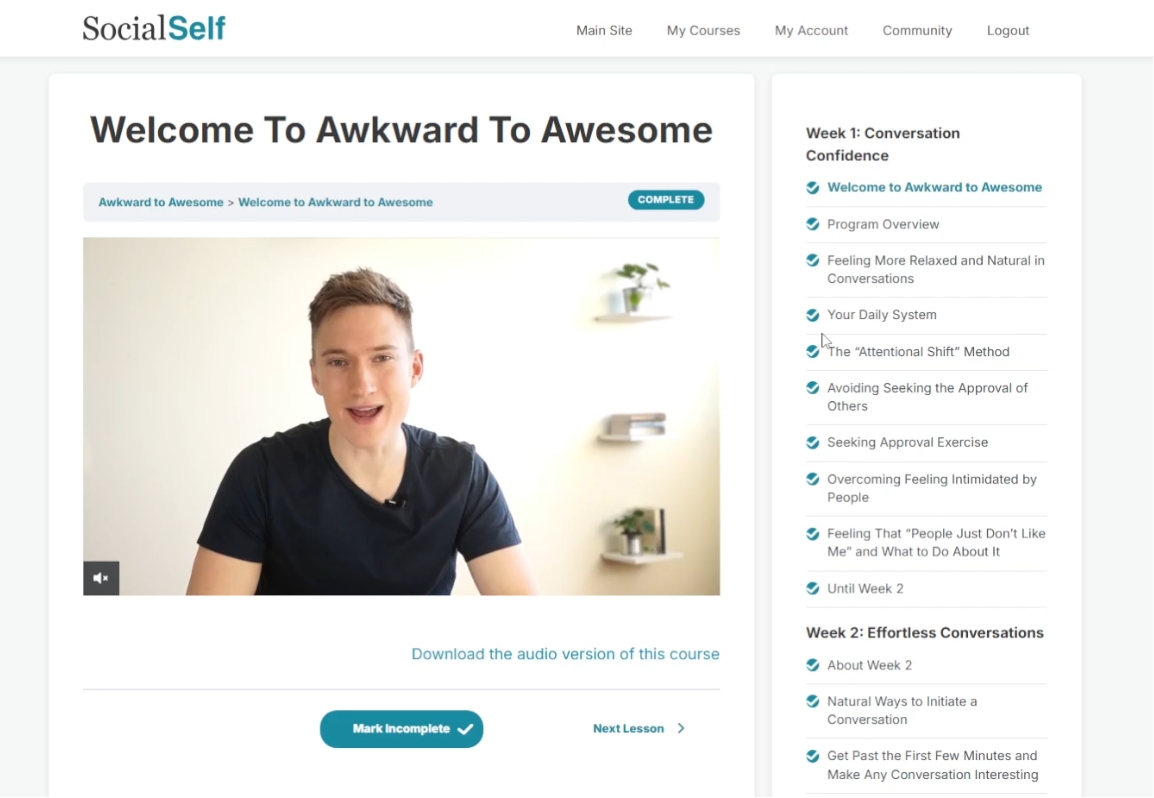
The first week works on two ideas that quietly run through everything after it. The first is micro-habituation, the practice of doing one small thing each day that sits slightly outside your comfort zone. The second is the attentional shift, moving your focus off your own performance and onto the person in front of you. David layers in a model of likeability built around attention, relatability, being in sync, balanced talking time, and genuine warmth. There is also a useful thread on intimidating people, which asks you to take them off the pedestal and look honestly at their own insecurities.
The whole course rests on one shift: stop auditing your own performance and start paying real attention to the person in front of you.
Week two moves into starting conversations and keeping them alive. The advice here is refreshingly unfussy. Scout for common ground, lead with warmth, listen in a way the other person can see, then steer toward more personal territory once trust is there. A technique called threading gets introduced as a quiet fix for awkward silences, letting you branch off to a new topic or circle back to an earlier one.
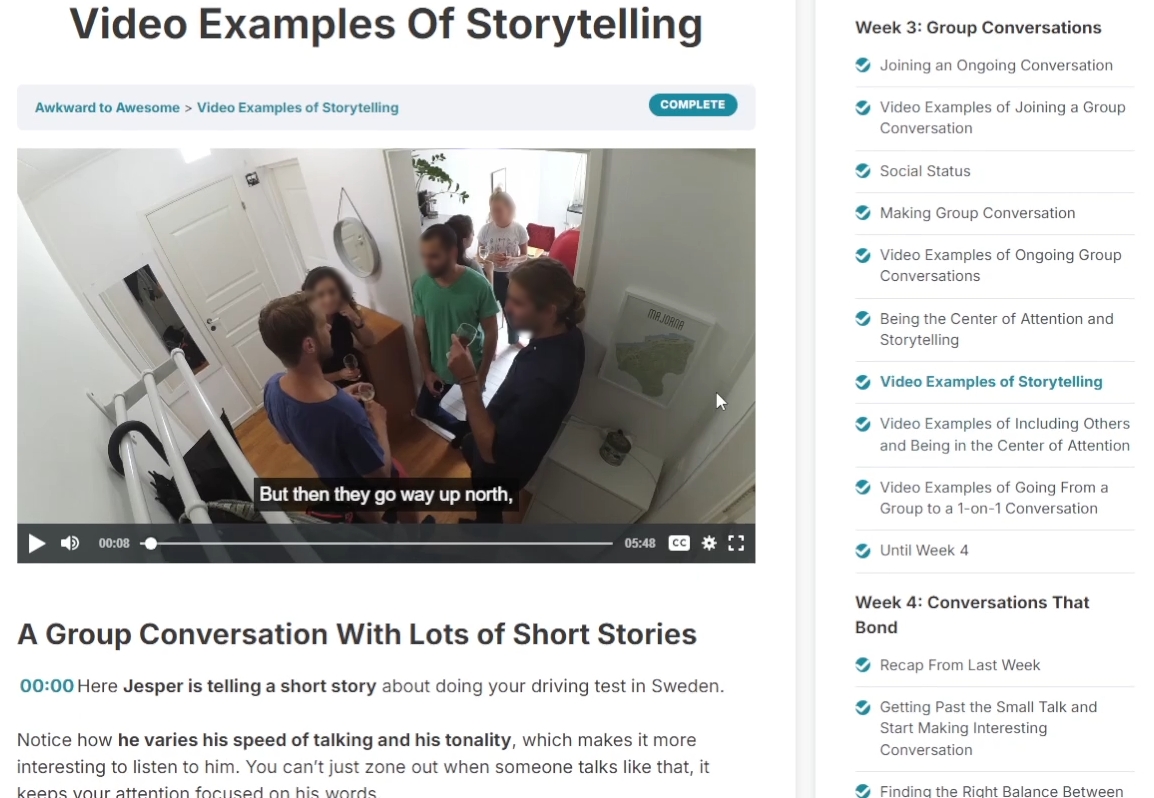
Week three is where it earned its price for me. The focus turns to group conversations, the situation that tends to undo socially anxious people fastest. David walks through how to enter a group using body language, curiosity hooks, and people's names, and how to tie your contribution back to something already said. The real-life footage carries this section.
The final week tackles the move past small talk. You work through opening up, sharing a weakness without oversharing, handling disagreement with some grace, and staying interesting on the days your life feels ordinary. Finding mutual interest does most of the heavy lifting here, and David gives you permission to test an assumption about someone to see whether a thread holds.
Much of the teaching happens inside recordings of a real social gathering, which the course then breaks down moment by moment. You watch someone listen well, hold eye contact, and make the other person feel safe enough to open up, and David annotates what is working and why. Picking these scenes apart taught me more than any of the bullet-pointed lessons did.
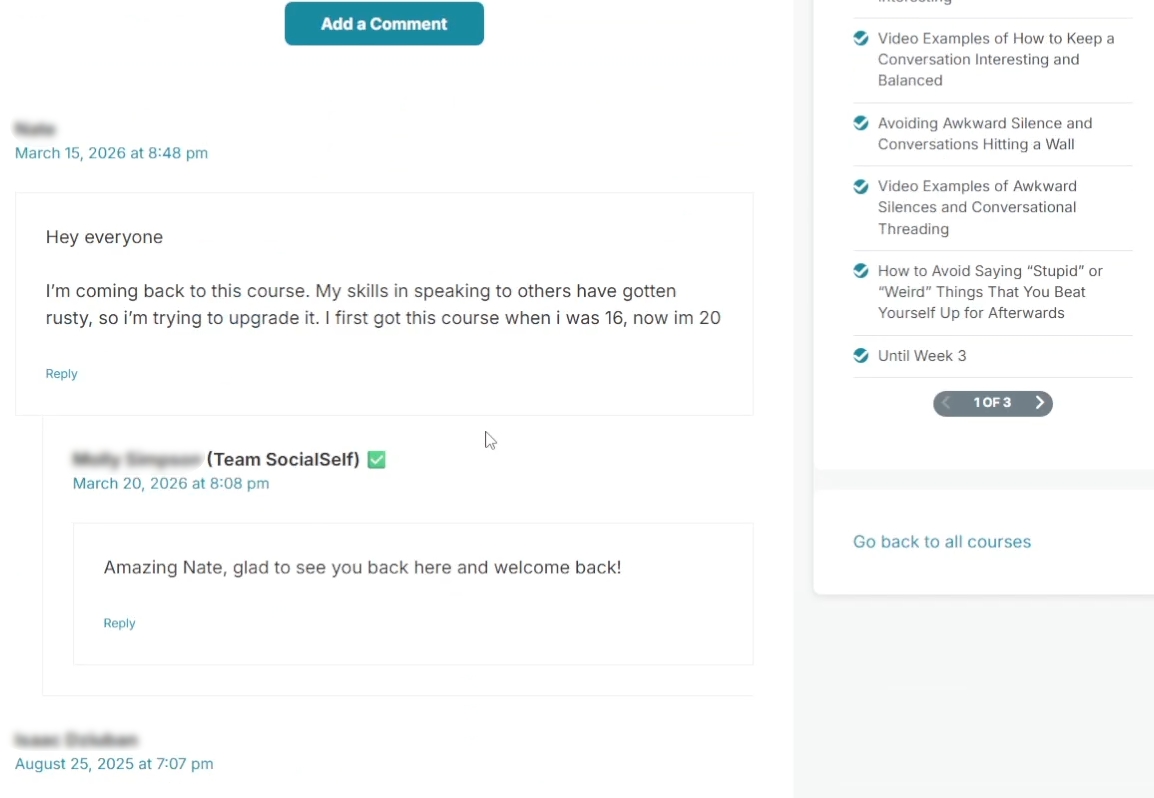
Each lesson sits above a comment thread where other members post their reflections and reply to one another. Reading how strangers wrestled with the same fears, and being able to post my own notes, gave the program a sense of company. The honesty in those comments stuck with me. Communication is done through the site's own asynchronous forum though, and a reply from another member or the team is never guaranteed.
The platform itself is the weakest link. The site feels dated, with the look of an early online-course template. Progress tracking is clumsy. You have to mark each page complete yourself, and there is no quiz or check to confirm anything actually landed. Long stretches play like a university PowerPoint presentation read aloud, and only the social gathering footage breaks the low energy.
Two gaps bothered me more than the dated design. The course presents itself as therapy-informed, yet lists no studies, references, or sources, so you are taking the psychology on trust. The second gap matters more for a program about meeting people: it never tells you where to actually go and find them. You finish with a toolkit and no obvious place to use it.
If you are an adult who functions fine at work and falls quiet the moment things get social, the framing will feel like someone finally describing your experience back to you. The approach is gentle and introvert-friendly by design and may work for you if you fit that personality type. People who want hard science, slick software, or an interactive experience should look elsewhere.
Good teaching and standout footage, held back by a dated platform and a few real gaps.
Awkward to Awesome earns a 7 out of 10 from me. The teaching is genuinely good and the real-life footage was very interesting and eye-opening. The dated platform, the missing sources, and the absence of any guidance on where to practice keep it from a higher mark. I would still recommend it to the right person, while giving them an honest take about what they'd be buying.