
Nobody ever taught you how to make eye contact. You were told to do it — by a parent, a coach, a LinkedIn post — but nobody showed you what good actually looks like, or explained the cost of doing too much. That gap matters everywhere, and it is especially costly in sales, where trust is the currency and every nonverbal signal gets read in real time.
Eye contact mistakes are fixable once you know what to look for. Most salespeople are unaware they are making them, which means they keep losing deals for reasons that feel invisible and frustrating.
What follows are the three most common eye contact errors in sales conversations, along with a practical correction for each.

Most people have heard that eye contact signals confidence, so they hold it as long as possible. They lock in, stay locked in, and push well past the point where the interaction still feels comfortable. What starts as an attempt to appear self-assured gradually tips into something that reads as threatening or socially unaware.
Research on gaze duration consistently identifies a crossover point around the four-to-five-second mark. Sustained contact up to that threshold registers as attentive and grounded. Held much longer, the same gaze begins to feel like pressure rather than presence. Prospects grow uncomfortable, shift in their seats, and start looking for an exit from the conversation rather than a reason to stay in it.
The people most likely to fall into this pattern are often the ones who have been working hardest on their eye contact. They have turned something that should feel natural into a conscious performance, and that effort becomes visible in exactly the way they were trying to avoid.
A salesperson who breaks eye contact naturally reads as more confident than one who refuses to look away. Ease is what signals security, not duration.
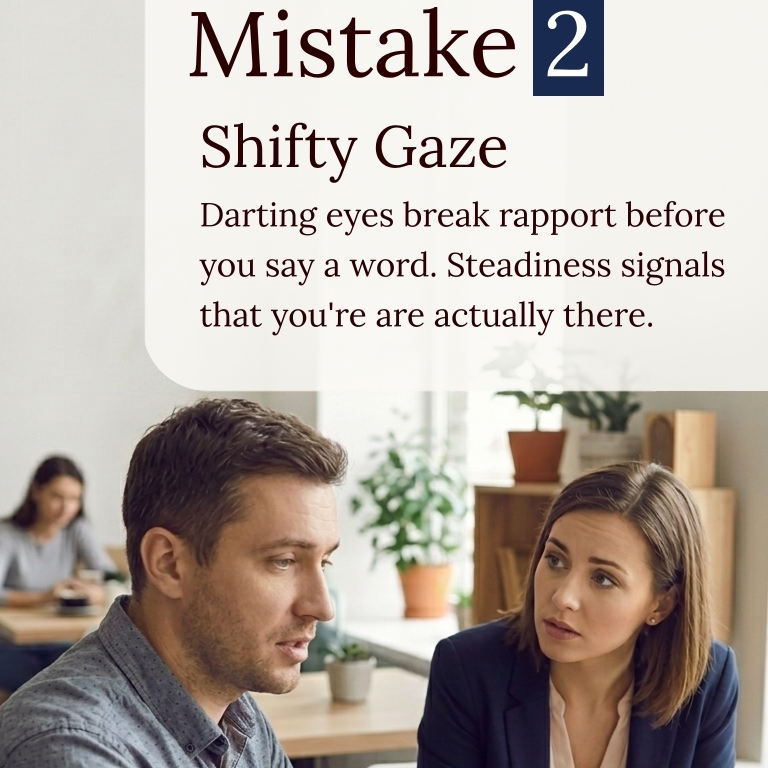
Some salespeople do the opposite: their eyes never settle. They scan the room, glance over a shoulder, check their notes repeatedly, and shift their focus every few seconds without any apparent reason. It might feel like natural alertness to the person doing it, but to anyone sitting across the table it registers as distraction, nervousness, or worse.
The human brain evolved to read gaze as a reliable signal of where someone's attention actually lives. Darting eyes tell your prospect that you are somewhere else mentally, that you are not fully committed to the conversation, and that their words are landing somewhere short of where they need to go. Rapport erodes before a single word of your pitch has been delivered.
Salespeople are especially prone to this when they are anxious, cycling through their internal script, or waiting for an opening to speak. The mind wanders and the eyes follow without the person realizing it is happening.
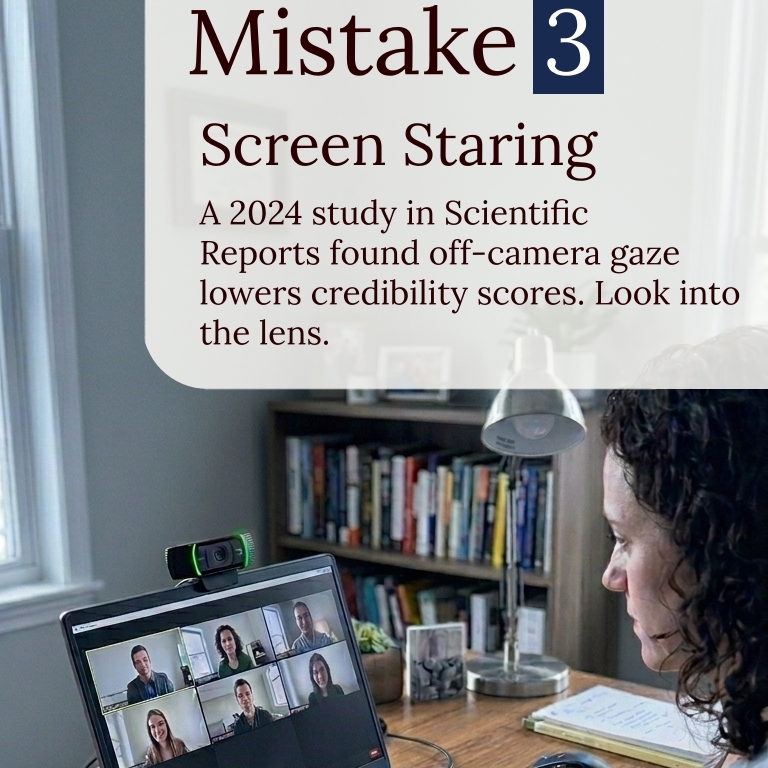
Remote sales introduced a structural problem that most people have not yet solved. The instinct on a video call is to look at the other person's face on screen, which is exactly what you would do in a room together. The trouble is that looking at the screen means looking slightly below the camera, and the person watching you sees someone who appears to be avoiding their eyes throughout the entire conversation.
A 2024 study published in Scientific Reports measured this effect directly and found that off-camera gaze produces meaningfully lower credibility scores. Participants rated speakers as less trustworthy, less engaged, and less authoritative when those speakers looked at the screen rather than the lens, regardless of what they actually said.
This is not a personal failing. It is a mismatch between how the technology works and how human perception works. Recognizing it is most of the fix.
None of these are personal failings. They are habits accumulated over years of unconscious behavior, patterns that were never examined because nobody ever gave people a reason to examine them. Most people were never taught how to socialize deliberately. They were certainly never taught to think carefully about how they use their eyes as a communication instrument.
Awareness is what changes this. Noticing a pattern is not the same as being stuck with it. Seeing these tendencies in yourself, even once, is what makes it possible to start doing something different.
Deliberate attention to where your eyes go, and why, is one of the smallest adjustments that produces some of the largest shifts in how other people experience talking with you.
A useful place to start: pick one of these three patterns to watch for in your next sales conversation. Just to notice it and don't try to correct it in the moment. That quality of calm, curious observation is where lasting change actually begins.